Bob Frank on Darwinian Econ, and a Call for Backbone in Obama’s 2nd Term

Bob Frank, Professor of Management and Economics at Cornell, is brilliant at framing economics in evolutionary terms. Visit his home page for some great articles, videos, NPR interviews, and books, if you want a quick tutorial in common sense economics.

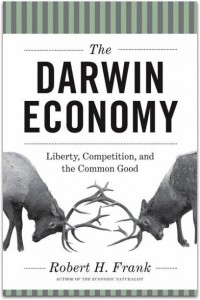
His new book, The Darwin Economy, is an elegant argument for why rising economic inequality hurts any economy, and why evolutionary competition always must be balanced against developmental cooperation. The Spirit Level, The Fair SocietyThe Impact of InequalityThe Great Divergence, and Wealth and Democracy are other highly recommended books in this vein.

To start,  we must recognize that certain levels of income and asset inequality are incentivizing and proinnovative. Think for example of the levels we see in Germany, Scandinavia, and other social democracies with innovative, healthly small business and strong industrial bases.
But if you don’t have a state that understands its critical role in limiting the income and asset divides via appropriate levels of income and estate taxation, they grow until they become counterinnovative. Cartels and collusions and special interest lobbying take over, incentives for inter-class cooperation are destroyed, and real bottom-up competition disappears. The folks at the top gain the economic means to change the rules to benefit just themselves, and the economy becomes a nepotistic kleptocracy, as seen in the kind of capitalism in autocratic states like Russia. Or the way Israeli capitalism is being captured by a few uberwealthy families in almost all the major industries (some areas of infotech a current exception). Marginal U.S. income tax rates over $2 million/year were 90% in Eisenhower’s term, and they are effectively 15-20% today, to our great shame. We’ve got a long way to go to get our house back in order.

Frank makes clear the unclaimed potential of an evidence-based bipartisanship emerging in coming years, and the real value of both liberal and conservative ideologies, policies, and rulesets in a capitalist social democracy. He also discusses the dangers of taking both right (libertarian) and left wing (nanny state) views too far, of giving either camp too much rope to hang themselves with.

Here’s a nice USA Today op-ed between liberal Frank and the conservative P.J. O’Rourke on how Liberals and Conservatives can get bipartisan agreement on infrastructure spending in a depression, and should avoid proposing visionary projects, which are anathema to each other. This has some merit to it, and I’d be excited about it if they were talking not about roads, which are of real but ever-declining relative value in a world of accelerating tech, but about digital infrastructure, as that is the greatest bottleneck holding back all kinds of new technical productivity in this country, as Yochai Benkler’s The Wealth of Networks (free PDF version) and other books eloquently describe.

The harsh reality is that big business, particularly big media and telcos, have always been able to derail fast-track digital infrastructure building, as it will of necessity disrupt their business models. Read my whitepaper, How the Television Will be Revolutionized, if you want some of the grim details on how big business has thwarted the arrival of real broadband for American citizens, and will continue to do so until we have political leadership with vision and backbone.

What we need is a President who recognizes that government must place the needs of society above the needs of big business, for key decisions. Obama felt he was that president, but he fatally decided that health care, rather than digital infrastructure, would be his first key play for reform. In a major recession no less. But health care reform won’t create the jobs we need, only a special combination of digital infrastructure reform, immigration reform, small business support reform, regulatory and tax reform, educational reform, and a few other key reforms will. Just as Keynesians know the state needs to save in a boom and spend in a recession, they should know you don’t do health care reform in a recession, but in a boom, or on the way out of one. By going up against the wrong big businesses for the time, and focusing first on health care over “jobs, jobs, jobs,” he crippled his political capital, and screwed up any chance of a productive jobs-oriented bipartisan alliance emerging on the hill for years to come.

The only reason it’s 60% likely he’ll get another term, as the useful prediction market Intrade will tell you, is because the other choice is no better, so we’ll stay with the incumbent. (Dear reader, I hope you are paying as little attention the U.S. presidential election circus as I am these days, as there’s far better things you can do with your precious time). Obama advisors, please read my post on The Race to Inner Space. What matters in tech policy if you want to accelerate national productivity in your second term is driving innovation in nanotech and infotech first, and every other technology (including health care, which already takes up a staggering 18+% of our GDP) second. Until we have a president who realizes this, our tech policy will continue to be unenlightened.

Fortunately, the smarter the web gets, and the smarter our circa-2020 AI assistants (cybertwins) become, the closer we’ll get to seeing the emergence of an evidence-based bipartisanship, and a plethora of evidence-based policies that advance our technical and human productivity. We may have to wait a decade to see meaningful political change, but oh what a decade of scientific and technical advance this one will be. I can’t wait.
The Moral Landscape – A Four Part Review (Part 4)

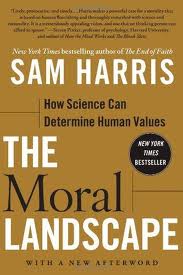
More thoughts on Sam Harris’s insightful new book, The Moral Landscape: How Science Can Determine Human Values, 2011. I read it with two friends, and interpreted it through an evo devo universe lens. I originally planned to critique the entire book but I’ve since moved on to other readings, so this will be it for now.

Chapter 3 follows:

The Moral Landscape, Chapter 3 – Belief

Agreements (and my rewording/additions in italics):

Harris uses the OED definition of belief, particularly “mental acceptance of a proposition, statement, or fact as true.”

This is helpful, but we can get more specific. I prefer the way the great 20th century philosopher, historian and science writer Jacob Bronowski approaches belief, in Science and Human Values, 1965 and The Origins of Knowledge and Imagination, 1979. As I recall him, Bronowski talks of 1. “intuition/faith”, 2. “philosophy/experience” and 3. “science/experiment” as three fundamental types of thinking. We accept propositions based on our intuition or faith, based on our philosophy or experience, or based on our science or experiment. Bronowski concludes the first book above with a Platonic dialog between an intuitive artist, a practical public servant, and an experimentally-driven scientist, and uses them to represent three potentially fundamental and complementary thinking styles: 

1. Experimental, creative, intuitive, and faith-based (evolutionary*) thinking
2. Adaptive, practical, logical/philosophical, experience-based (evo devo*) thinking
3. Scientific, factual, replicable experiment-based (developmental*) thinking 

*The labels in parentheses are my additions to Bronowski’s model. I’m not sure, but I believe 🙂 he would have approved. As Harris reminds us, all of these are technically beliefs, but as Bronowski reminds us, the first category of thinking styles is the most common connotation for belief, the second is rational argument or experience, the third is science. This is a very practical categorization system for our thinking.

In these books, and in his sublime BBC documentary series and book, The Ascent of Man, 1976, Bronowski regularly visits these three categories of thought, and convinces us that we use and need all of these types of thinking to survive and thrive. In common parlance, beliefs are thoughtful intuitions and faiths that we have little justification for, beyond gut feeling or social custom. Thinking them to be true is an individually and socially creative act. We also have thoughts that have some practice, experience, logic, or philosophy to guide them. Finally, we have thoughts that have been to some degree validated via experiment, replication, scientific method. Bronowksi argues that we always need intuition, but as society matures, we increasingly gravitate away from pure faith-based thoughts to ones more informed by philosophy and experience, and in special cases, scientific knowledge, to the great benefit of civilization. But intuition, and a modicum of faith, must always remain, no matter how complex we become. Thus religion never goes away, nor should it, but it does get continually reformed.

“The less competent a person is in a given domain, the more he will tend to overestimate his abilities.”

This has been described as the Dunning-Kruger Effect, and is one very important source of cognitive bias. Ignorance and certainty often go hand in hand. One hallmark of complex thinking is when we qualify our statements, and are aware of places where we have a number of competing theories, all of which have some merit, and where we presently have insufficient data to form a judgment. We need to be tolerant of uncertainty and ambiguity, as it is a key component of nature itself, with its profusion of evolutionary experiments, many yet to be judged by the environment. In fact, we have to move beyond tolerance to actively championing diversity and experiment, especially in those controversial and uncertain areas where the right way or ways are not yet clear.

“The level of humility in scientific discourse is one of its most striking characteristics.”

Well said. The way that even a Nobel laureate usually speaks about subjects outside their expertise (there are of course exceptions) is something we should all strive for, in our discourse about the deepest and most important things, like our beliefs and values.

“Political conservatism… is a fairly well-defined perspective characterized by a general discomfort with societal change and a ready acceptance of social inequality… The psychologist John Jost and colleagues analyzed data from twelve countries, acquired from 23,000 subjects, and found this attitude [political conservatism] to [also] be correlated with dogmatism, inflexibility, death anxiety, need for closure, and anticorrelated with openness to experience, cognitive complexity, self-esteem, and social stability.”

Brilliant diagnosis! Yet we must recognize that liberals are equally “conservative” (parochial, protectionist, change-averse) on the economic dimensions of society. They gravitate to trade restriction, to onerous economic guarantees,  to high trade barriers, to change-averse unions, jobs for life, etc.

Liberals, in other words, are socially evolutionary (freedom oriented) and economically developmental (constraint oriented, tariffs, unions, guaranteed wages). Conservatives are socially developmental (constraint oriented) and economically evolutionary (freedom oriented).

Conservatives are the natural leaders in socially developmental aspects of our society (defense, security, intelligence, rulemaking, social norms and traditions) and in the economically evolutionary (market, innovation oriented) aspects as well. Liberals are natural leaders and key players in all the social innovations of modern societies, and in all positions of power involving constraint and regulation of economic activities. Both play critical evo and devo roles. Demonize either and you miss seeing why the system works as it does.

“If a person’s primary motivation in holding a belief is to hew to a positive state of mind—to mitigate feelings of anxiety, embarrassment, or guilt, for instance—this is precisely what we mean by phrases like “wishful thinking” and “self-deception.” Such a person will, of necessity, be less responsive to valid chains of evidence and argument that run counter to the beliefs he is seeking to maintain.”

Well said. We must be willing to undergo mental disruption and discomfort, to unlearn bad beliefs, if we seek to live an evidence-based life. Ideally, we will allow such disruption to become increasingly frequent the older we get, as there is more known, and more we have to unlearn, at least in particulars. If we can live with this disruption, we can be the kind of elderly that grow in wisdom and stay relevant, even as our knowledge must become both increasingly general and conditional, and our ability to change the world gets increasingly narrowly defined. Fortunately, our electronic extensions are continually rejuvenating themselves, and the more we embrace them, the more resilient we become.

The neurologist Robert Berton, On Being Certain, 2008, says schizophrenia is a disorder of pathological certainty, and obsessive compulsiveness is a disorder of pathological uncertainty. Certainty is primarily an emotional process, and is connected to but different from the chains of evidence and argument that determine the correctness of any belief.

Lovely insights.

There are genetic differences in the types and quality of human reasoning. “People who have inherited the most active form of the D4 [dopamine] receptor are more likely to believe in miracles and to be skeptical of science; the least active forms correlate with rational materialism.” There are also genetic differences in our innate risk tolerance, which in turn greatly influence our reasoning and conclusions. Does this variation mean that we cannot identify unproductive extremes? No.

Enlightening! Nurture’s contribution to human mental life gets steadily clearer.

I expect that in the future, we will come to understand two fundamental things about the genetic differences in human reasoning and belief systems: 1. There is a developmentally healthy envelope of variations in risk tolerance, willingness to believe strange things, and other thinking parameters. The vast majority (usually 99%?) of humans are almost always functioning within this envelope, and those times when they aren’t we can define as deprivation or disease. 2. Within this envelope, there is no developmental “optimum” that we can usefully define. Having a healthy evolutionary variety and distribution within the envelope of normal function will turn out to be as important as having developmental bounds on the size of the envelope.

This is all that will be left of the “eugenics” visions of the 20th century reductionists: just a better definition of the exceptional cases of disease, not discovery of an optimal configuration among a great variety of healthy norms. As healthy thinking is an evolutionary process, adaptation will always remain contingent and dependent on local context, and impossible to globally predict or define.

“Skeptics given the drug L-dopa, which increases dopamine levels, show an increased propensity to accept mystical explanations for novel phenomena. The fact that religious belief is both a cultural universal and appears to be tethered to the genome [and dopamine levels in the brain] has led scientists like [Robert] Burton to conclude that there is simply no getting rid of faith-based thinking.”

Absolutely! I doubt Harris would agree with this, but I see these dopamine experiments as beautiful evidence that our very brain machinery is biased to make us do: 1. Intuition/faith-based thinking, 2. Argument/experience-based thinking, and 3. Scientific/experimental-based thinking. All three are fundamentally necessary processes for thinking creatures in our universe, in my evo devo view. 

“Reason can bridge the gap between believers and nonbelievers.”

Harris explores how we purged such harmful beliefs as the belief in Witchcraft, and the cruel punishments that purported witches received in the West a few hundred years ago, and which they still receive in some African nations today. Reason can help us sort out harmful and regressive from progressive beliefs. But while I agree strongly with him here, I also think our human need for a rather large set of faith based-beliefs remains fundamental, in a world where complexity, for now, remains far greater than our minds.

Disagreements:

“There does not seem to be a process in nature that allows for the creation of new structures dedicated to entirely novel modes of behavior and cognition.”

Disagree. We can’t yet say this definitively, but I’d bet universal evolutionary development guarantees regular emergence of new behavioral and cognitive novelty. I’d bet the consciousness and behavior modes of a human are qualitatively novel vs. that of an insect, and I’d predict the AI’s hyperconsciousness, given its new level of structural freedoms, will be qualitatively novel yet again.

“Much of our behavior and cognition… has not been selected for at all.”

Strongly disagree. All our behavior and thought undergo memetic selection. You just choose not to see or discuss it. You seem to be in the Denial phase of the death of an ultra-Darwinian world view (Denial, Anger, Bargaining, Death, and Acceptance being the full progression). You don’t even confront or critique the 35 years of literature on memes, in your entire book. I recommend Bob Aunger’s Darwinizing Culture: The Status of Memetics as a Science, 2001 as a start into that literature.

“I have argued there is no gulf between facts and values, because values reduce to a certain type of fact.” [Harris found both constructs used the medial prefrontal cortex (MPFC) and emotional areas in his research].

There is no such “reduction” occurring. It’s interesting that both scientific and ethical constructs use the MPFC and emotion, but that doesn’t make them the same. Ethical judgments are a subset of scientific judgments. Some ethical judgements are factual-scientific (developmental) others are creative (experimental) and they may or may not be or turn out to be factual. 

On Lie Detection science: “Whether or not we ever crack the neural code, enabling us to download a person’s private thoughts, memories, and perceptions without distortion, we will almost surely be able to determine, to a moral certainty, whether a person is representing his thoughts, memories, and perceptions honestly in conversation.”

I don’t share Harris’s faith in the perfectability of this science, by imperfect humans at least. Better lie detection will surely weed out the amateurs, but it will also breed better liars. The best liars, the ones that beat polygraphs today, are capable of amazing feats of self-deception, and belief in their own lies. Those that dissociate (create multiple personalities) may be detectable by neuroimaging, but what of those that learn to believe their own lies with their “whole mind”?

“Choosing beliefs freely is not what rational minds do.” [On his debate with Philip Ball].

Strongly disagree. In the realm of our intuition and faith-based thoughts, quite a number of these beliefs are freely and consciously or unconsciously chosen, based on how they make us feel, as Philip Ball apparently argues, and it is rational to do this. When we get argument or experience, or even science to constrain these beliefs, it is also rational to revise our beliefs. But we often don’t have even argument or experience to guide our first beliefs in an abstract or new area of thought. The act of intuitive or faith-based belief, the search for propositions that we think might be true, is a creative action, a necessary evolutionary step toward greater adaptive complexity and development.

“Believe a proposition because it is well supported by theory and evidence; believe it because it has been experimentally verified; believe it because a generation of smart people have tried their best to falsify it and failed; believe it because it is true (or seems so). This is a norm of cognition as well as the core of any scientific mission statement.”

Yes, but this is only a subset of the beliefs we use and need! Many of our beliefs are intuitive, or faith-based, and may not yet even be conscious, much less supported by argument or evidence. Consider our faith that the universe is comprehensible, or amenable to life, or people mostly moral. Most of our thinking may be based on such bottom-up, neural-net constructed beliefs. They are the foundation on which the tip of our conscious beliefs, argument, evidence, and science has emerged. We shouldn’t ignore them. At the same time, we can marvel that even with this sea of intuitive thinking as our inheritance, so much rationality emerges so predictably in all of us. Developmental psychology is yet another amazing example of the power of universal development.

Thoughts? Comments? Let me know, thanks. [tweetmeme source=”johnmsmart” only_single=false]

The Race to Inner Space: Our Ever Faster, Smaller, Smarter, and Wealthier Future

Seeing, Guiding, and Benefiting from Accelerating Physical and Informational Change

Humanity’s advances to date have been accompanied by great leaps in the density, diversity, and virtuality of our societies, and in the miniaturization and efficiency of our technologies. Among these and other variables determining social progress, two stand out as particularly special. The more our intelligence gains access to “Inner Space,” both to the domain of very small size scales, or Physical Inner Space”, and to the domain of very powerful brain-based and computer-based simulations, or Virtual Inner Space”, the faster we learn to generate major new economic, social, and adaptation benefits for civilization. This “Race to Inner Space” may turn out to be the dominant developmental trend for our species.

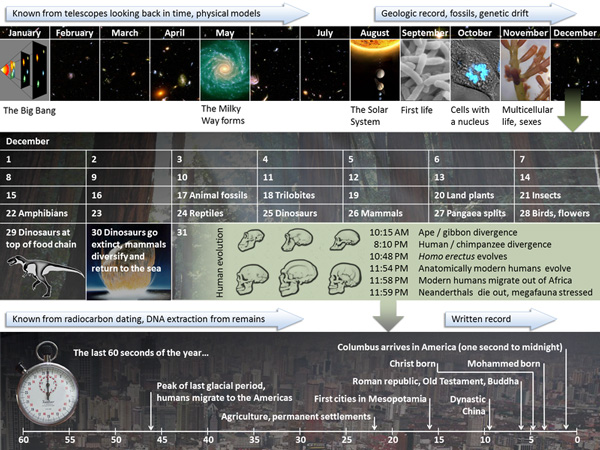
The Cosmic Calendar: 13.7 Billion Years of Universal History Depicted Over A Cosmic “Year”. Lovely creative commons image by Wikipedia author Eric Fisk.

As Carl Sagan famously argued in the Cosmic Calendar metaphor of Big History, life on Earth has been engaged in a continual acceleration of structural and functional complexity emergence since its birth 3.8 billion years ago. At the same time, each newly emergent complex system, from stars to cities, from prokaryotes to computers, uses vastly smaller quantities universal space, time, energy, and matter or STEM, per novel information production, computation, or physical transformation, than the system that came before it. We may call this phenomenon STEM efficiency and density increase, or STEM compression, and we can see and measure it in spatial, temporal, energetic, and material terms. Over time, the leading edge systems use ever less of the resources of “Outer Space” to generate ever more novelty, intelligence, and capability in “Inner Space”, an exciting and apparently universal process. If this astonishing trend continues, our and other universal civilizations may eventually reach black hole level computational efficiency and density and transcend our universe, a topic I’ve speculated on in the Transcension hypothesis.

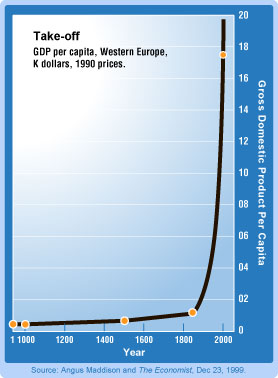
Certainly humanity’s ability to think, act, and shape our world has grown ever faster, more powerful, and more novel since Australopithecus garhi, perhaps our earliest tool-using ancestors, fashioned the first stone tools more than 2.6 million years ago. We are also much more densely associated in our cities, and engaged in far more virtual activity than our ancestors. Since the advent of currency circa 5,000 years ago, human wealth production has also become an increasingly instantaneous and virtual economic process, today involving trillions of dollars in daily foreign exchange and billions in program trading. Though modern economies experience occasional recessions, these grow rapidly shorter with time, and even the worst now last less than one decade, just one seventh the typical human lifespan. Surprisingly, these periodic slowdowns are not even visible on long timescales. The curve to the left, charting GDP per capita in Western Europe from 1000-1999 AD, with data compiled by economist Angus Maddison, shows that global wealth production now grows almost instantaneously fast over the span of a century. Reporting on this in The Economist in 1999, the authors said it “looks less like an inevitable process and more like a single, astonishing event.” In my opinion, this acceleration, just one of several special Inner Space trends in human civilization, clearly does look like it might be an inevitable process, and it is precisely this parochial attitude, this failure of vision and lack of willingness to ask unpopular questions about value creation and technological change, that keeps today’s media from seeing and reporting on accelerating complexity development, and that keeps today’s economic theory ignorant of the inevitable accelerating benefits that come from our investments and actions in Inner Space.

At the same time, as Kevin Kelly notes in What Technology Wants, 2011, the redundancy of our technology and its distributed knowledge systems protects this accelerating planetary process of wealth and knowledge creation better than ever before. While individual nations, regions, companies, and individuals regularly suffer slowdowns and catastrophes, our global system, like an organism with a developing brain and immune system, rebounds from damage faster, stronger and better the more complex it gets. The story of our accelerating resiliency to complexity disruption, however, is even more ignored, ridiculed, and unaccepted today than the story of accelerating change. We need to fix this state of affairs. The longer we ignore planetary processes of collective intelligence and immunity development, the longer our political, economic, technological, and social policies remain unenlightened, ineffective, and focused on the wrong goals. The longer we wait to study these processes with the rigor they deserve, the longer we remain burdened with preventable suffering, living in the flatlands below the knee of the next growth curve of capacity building, intelligence advancement, and wealth creation.

I believe that humanity’s collective intelligence, wealth, and resilience have accelerated for so long because, via STEM compression, we have continually learned how to move our intelligence into ever smaller domains of nanotechnology, or Physical Inner Space, thus escaping resource limits, while at the same time, developing ever smarter simulations, or Virtual Inner Space, so we can “think more” and “act less” in the search for new capabilities and wealth-creating innovations. Today, a growing proportion of our leading innovations happen either at very small scales in physical, chemical, or biotechnological processes, or inside computers and their networks and software. It is only these special systems that use less and less physical resources to produce more and more social value, a process that the futurist Buckminster Fuller called “ephemeralization,” or doing more and more physical transformation (“acting”) and simulation (“thinking”) with less and less space, time, energy, and matter, or STEM. In a very real sense, we are “moving the world” to Inner Space at an accelerating pace, as depicted in the fullerene (“buckyball”) molecule enclosing Earth in the pretty picture to the right by nanoscientist Chris Ewels.

In humanity’s great race to Inner Space, we are on the edge of major new breakthroughs in nanotechnology engineering, and of the web becoming a metaverse, the most intelligent and valuable natural environment on the planet. We may soon see such infotech and machine intelligence advances as a conversational interface (a web that understands us when we talk to it), digital twins (aka “smart agents”, semi-intelligent avatars that can model and represent us), a valuecosm (quantified maps of all our values and goals), and statistical measures of our individual and social progress. These seem likely to be very empowering and democratizing innovations.

These same nanotechnologies and information technologies offer all the leading solutions to today’s greatest global challenges, including cheap energy and CO2 reduction (nanosolar, which doubles global installed base every two years, and halves its cost every ten years, engineered algal biofuels, which for some applications are now the same cost as oil, fuel cells, etc), food (a genetic green revolution), water (nanodesalination, which doubles global installed base every six years, and halves its cost every nine years), reducing poverty, overpopulation, and slums (smart internet, internet TV, online education, science and technology education, entrepreneurship, women’s and civil rights, green cities), reducing crime and terrorism (global transparency and sousveillance) and bioterrorism (immune system aids like DRACO), and building trustable machine intelligences and robots (we may evolve our machines to be trustable, just as we have bred domestic animals to be trustable, without “designing” them). Even human death is in the process of being challenged. For those who die today, one path to further life may be chemical brain preservation at death, followed later by advanced and inexpensive nano and information technology. Every major human problem we see today has one or more Inner Space technical solutions on the horizon.

How do we help more of our leading countries, institutions, corporations, and entrepreneurs to understand and benefit from our civilization’s apparently inevitable race to Inner Space? How do we get this realization to become part of the story of Big History, told to all curious children who seek to understand the universe? As the pace of life speeds up, many people and organizations react with fear and fundamentalism to accelerating change. How do we help them instead to embrace the most humanizing technologies, and to develop a continual learning and evidence-based culture? For how much longer will our political and corporate leaders continue to severely underfund global nanotech? The world’s governments spend just $10B/yr annually on nanotech R&D funding, with the US spending just $2.2B annually, primarily via the National Nanotechnology Initiative. This is just 0.3% (0.003) of our $740B defense budget in 2010. Just 0.06% (0.0006) of our $3.5T in federal spending. Since 2011, China now spends more on nanotech R&D than the US, with just one fifth our GDP. This positions them to start far more of the nanotech jobs of the future. We should be competing much more on that front.

We also seriously underfund global infotech. The US spends almost all of its unclassified investments in infotech R&D through the Networking and Information Technology Research and Development (NITRD) Program. As of 2007, NITRD spending was just $3B/year. You can bet it hasn’t gone up since then, given our recent economic woes. How long until we change our priorities? How many great nano and infotech solutions to our present global problems are we presently ignoring, instead wasting most of our precious time, intelligence, and energy on far slower, cruder, and less inefficient “Outer Space” technologies and strategies? I suspect every nation on Earth, and many companies, spend a good deal less on nanotechnology and information technology education, research, development, strategy, and entrepreneurship than they should, given the continually accelerating returns delivered by these special technologies. I know that nations and companies rarely have good forecasts of accelerating returns in Inner Space to guide their policy, or to time their product development strategy, because I’ve been a scholar this field for ten years now. The world, by and large, is not yet awake to this trend. We are all running a race, but most of us are not yet conscious of it. That needs to change.

Fortunately, some nations, regions, and companies do a much better job promoting technological progress than others. Some prioritize science and technology policy, education, research and development, innovation, and foresight. Some encourage competitions and give scholarships and hiring priority to the most technically proficient, innovative, and entrepreneurial. But few nations give sufficient access to credit and other startup resources for their best technology entrepreneurs, or create fair competition environments to allow both large and small businesses to create new technology products and services. As citizens, we often don’t measure and rank our local, state, and national politicians for their science, technology, innovation, and entrepreneurship credentials, and reward them with our votes. As consumers, we don’t always look for, rate, and buy the smartest and most resource-efficient products and services, as soon as they become available. I believe the best way to improve the world is to recognize where it is going, to Inner Space, and to see the powerful role that each of us can play in building a much faster, smaller, smarter, and wealthier future for all of us.

[This is the abstract of a talk I will give at Global Future 2045 in Moscow, February 2012, to a community of Big History scholars, entrepreneurs, futurists, and transhumanists. Hope to see you there.]

Thoughts? Disagreements? Corrections? Let me know, thanks! [tweetmeme source=”johnmsmart” only_single=false]