Returning to First Century Palestine for Lessons on the Future of Religion – Reza Aslan’s Zealot, 2013

Aslan sketch_10.indd

Zealot, 2013

I’ve just finished a lovely book, currently #4 on the NYT Nonfiction Bestseller list, that I recommend highly for those seeking to improve their personal spirituality and understanding of religion, Reza Aslan’s Zealot: The Life and Times of Jesus of Nazareth, 2013. First a personal disclosure: My parents were raised, and they raised their children in the Lutheran branch of Christianity. But like many a learning-oriented youth I had increasing difficulty reconciling the logic and aspirations of modern texts (primarily, the lovely World Book) with the illogic and wrath of large parts of the Bible. I started taking notes in the margins to document my disagreements, and began dropping whole sections from my mind, beginning with most of the Old Testament. By my young adulthood I ended up focusing on the parts of Jesus message I really admired, and I came to understand him as a courageous spiritual leader, a champion of the downtrodden, and a failed revolutionary who was very much a product of his time and culture.

monty-pythons-life-of-brian-messiah

Life of Brian, 1979

Do you remember Monty Python’s Life of Brian, 1979? In particular, that scene with all the messiahs in the marketplace, competing for followers? It turns out the truth isn’t that far from that famous skit. First Century Palestine was a highly competitive breeding ground for would-be messiahs, with rationality in short supply and populism, passion, rhetoric, and tricks like exorcism and miraculous healings as standard tools of the trade for a large class of itinerant preachers. Will and Ariel Durant covered this well in their amazing and epic Story of Civilization, 1935-75, parts of which I read in college.

One of Azlan’s gifts is that he resurrects that easily-forgotten world in the first twelve chapters of Zealot, in a well-crafted, suspenseful story. He begins by introducing us to the Maccabees, zealous guerilla-fighting Jews who recapture Judea and Jerusalem from the Seleucids in 164 BCE, after four centuries of non-Jewish rule. Then we see the Jews sadly lose control of their beloved homeland again in 63 BCE, when Rome conquers Jerusalem under Pompey Magnus, putting Judea under tithe and hated centurions in control of the holy Temple. He retells the hopeful prophecies in Judaism for a coming messiah (a new king, revolutionary, savior, prophet) who will smite the enemy and usher in a new “Kingdom of God” on Earth. We are introduced to scores of failed messiahs from this era (at least a dozen self-proclaimed messiahs are known, even with the poor records of the time) who each gain followers, even for years, yet most are eventually captured and crucified, the classic punishment for revolutionaries.

We next see the rise of Jewish Sicarii, stealthy assassins who use small daggers, hidden in cloaks, to secretly and effectively kill Romans and Roman sympathizers in crowds in public, and we see them eventually even murder the Temple’s head priest Jonathan of Ananus, a hated stooge of Rome, in 56CE. By 66CE, these passionate revolutionary Jews have risen up and expelled the far more powerful Romans from Jerusalem, and they are kept out for four entire years. At the end of the Jewish Revolt, in 74CE, almost a thousand Sicarii, men, women, and children, kill themselves en masse at Masada, rather than give the Romans the pleasure of doing so. That’s a level of zealotry, of fervent, extreme, and revolutionary belief and action in support of one’s religion, that we can scarcely understand today.

JesusMoneyChangersRevolutionary

Jesus in the Temple

This history gets us ready to understand Jesus the revolutionary, Jesus the zealot, Jesus of Nazareth, who lived for some 30 years and who built the foundation for perhaps the most successful movement of religious believers the world has yet seen. The study of the real Jesus, and the attempt to uncover his true life and beliefs is called Jesuism (Jesuology might be more accurate, but it doesn’t seem to exist). As the wikipedia page on this topic reminds us, Jesus was a revolutionary, a communalist, and a transcendentalist, as well as being thoroughly a Jew. Even in the heavily redacted New Testament, pieces of the revolutionary Jesus remain.

We see a Jesus who had his disciples sell their cloaks for swords in Gethsemane (Luke 22:36-38). We see him “Cleanse the Temple” in Jerusalem using physical force (Mark 11:15-33). And he says things like:  “Do not think that I have come to bring peace on earth. I have come not to bring peace, but the sword.” (Matthew 10:34).  Of course, all of this is heresay, written mostly by followers who didn’t know him personally, many decades after his death. What Jesus said and did in his life is largely a mystery. Yet Azlan takes us one step closer to uncovering that mystery, and presenting it as an epic story, and we must thank him for it.

Bartolomeo_PaulofTarsus

Paul the Narcissist

But I think it is Part III, the last three chapters and epilogue, where Zealot really shines. Here we are introduced to Paul of Tarsus, an urbanized Roman Jew who was a serious narcissist, power-lover, and yet another would-be messiah, born a few years after Jesus’s death. After at first unsuccessfully persecuting the early believers in Jesus, and no doubt impressed with how both stubborn and kind they were to him in return, in a flash of inspiration he realized this new religion’s weak spot – by fashioning himself into a “new apostle”, alleging divine communication with the dead Jesus, and preaching an even easier and broadly palatable version of Jesus’ teachings than the others on offer, he could take control of this new movement himself. In his fights with the other versions of Christianity on offer Paul says things like (“If anyone else preaches a gospel contrary to the gospel you received [from me] let him be damned” (Galatians 1:9) even if it comes “from an angel in heaven” (Galatians 1:8), instead, “be imitators of me, as I am of Christ.” (1 Corinthians 11:1). Most importantly, Paul’s version of the gospel requires only a simple and easy faith in the divinity of Jesus as the sole means to salvation for the believer.

This Pauline Christianity is geared toward gentiles, not just Jews, and toward the urban Romans. It ignored Jesus’s unpopular revolutionary ambitions, and did away with the need for good works and law abidance for salvation that we find in Judaism. Paul’s is a modern, sanitized faith for a New Wealthier and Lazier Age, and it eventually won the battle over the more popular form of Christianity taught in Jerusalem at the time by James, Jesus’s younger brother, which bitterly condemned wealth and was much more devoted to the Torah, both unpopular with Roman audiences. Pauline Christianity keeps growing with gentiles in Rome, and eventually becomes adopted as his own religion by the Roman Emperor Constantine in the 300’s. He convenes the First Nicene Council to settle conflicting Christian beliefs in 325CE, and it becomes the official religion of the Roman Empire in 380CE. When the official New Testament is finally assembled at Hippo Regius in 398CE, more than half of the twenty-seven books that make the cut are either by or about Paul.

His message has won, and Christianity has become a largely Roman invention, as well as a lasting gift the world. At the same time, beginning with barbarian invasions in 376CE and concluding with the murder of the last emperor, Julius Nepos, in 480CE, the Roman Empire itself entered a long and tragic collapse, from which its new religion could not save it.

It is all such an amazing story, and our historical records get better every year at piecing together the key details. Aslan, @rezaaslan, is a co-founder of BoomGen Studios in NY. They do “Transmedia Storytelling”, blending history, education, and entertainment, in different media formats, like graphic novels (think of Persepolis2000), textbooks, video games, and films, in a way where people and institutions will pay for their own edification. Mahyad Tousi, @MahyadT, is BoomGen’s co-founder. I recommend Tousi’s inspiring TEDx talk, The Future of History, for more on transmedia uses of history to edify-educate.
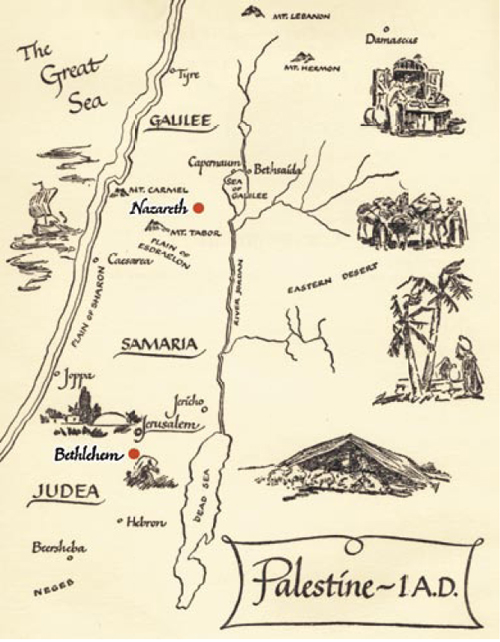
First Century Palestine

First Century Palestine

I don’t know if Aslan and Tousi are thinking about doing a graphic novel of Zealot next, but I bet they could crowdfund one on Kickstarter if they choose. Eventually we can expect to see a film. A great film would immerse you in the incredibly messianic and violent world of First Century Palestine. It would show you how the idealistic, communalist, revolutionary Jew, Jesus of Nazareth lived and what he likely said and thought. And it would show how Jesus of Nazareth was turned into Jesus the Christ in the decades and centuries after his death, by a lot of motivated people, for many compelling reasons.

A good film series on the evolution and development of the Christianity story could be particularly helpful for lapsed Christians who are moving toward the evidence-based destinations of scientific naturalism and agnosticism. It would also show how all successful religions continue to reform themselves, and that the only real moral problem with the major monotheistic religions is that they all stopped editing their scriptures about 1,000 years ago, while science continues to edit its morality story faster and more usefully every year.
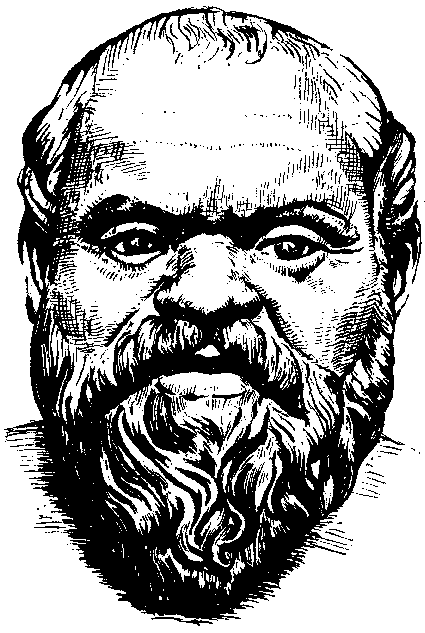
Socrates, Champion of the Individual Mind

Socrates, Champion of the Questioning Mind

A great prequel to the Christianity story might begin with the birth of the modern secular naturalist mind in Greece, beginning with Thales, 624-546 BCE, perhaps the first great Western secular humanist, philosopher and mathematician. We could also meet Cleisthenes, who brought democracy to Athens circa 550 BCE, which would lead us to Pericles, the great secular leader of Athens in its Golden Age, 480-404 BCE, and next to Socrates, 469-399 BCE, who championed:

1. Questioning as a method of continual self- and world-improvement,
2. Agnosticism (knowing of nothing with certainty, including God),
3. Dualism (humanity’s body/behaviors and soul/mind are equally important),
4. Asceticism (earthly things are less important than one’s soul/mind/morals) and
5. Never retaliating to those who do you wrong.

We can imagine that if Socrates had been not only nonretaliatory but more empathic and humble, prizing people’s feelings as high as their thoughts, he likely wouldn’t have been sentenced to death for impiety and “corrupting” the minds of youth. He was not a revolutionary (Jesus was, and so his path was fated once he allowed himself to be called messiah), but a patriot. We can also imagine that if Socrates had also promoted careful observation, measurement, and physical experimentation, closely watching and building things in the physical world, not just in the mind, we would have had a clear statement of the scientific method in our philosophy of knowledge about 1600 years earlier than we did. So close, yet so far!

Aslan, who also wrote the acclaimed No God But God: The Origins, Evolution, and Future of Islam, 2011, considers himself a reform Muslim. I know many reform religious members who are also openly or secretly naturalists and agnostics. That’s the main trend for the future of religion, I think: increasing numbers of us being members of some religious or spiritual community, but no longer sanctioning woo-woo language, scriptural falsehoods and hypocrisies. Protesting those parts of the story we don’t like, because our gut, or science, tell us they are wrong. That road has led to a 2013 Pope who has finally caved to homosexuality, for example. All we needed were enough Catholics speaking out, and enough empathy for gay Catholics. We could have also looked to all the nonhuman species, in order to see how natural a sexual variation homosexuality actually is. Who are we to judge indeed.
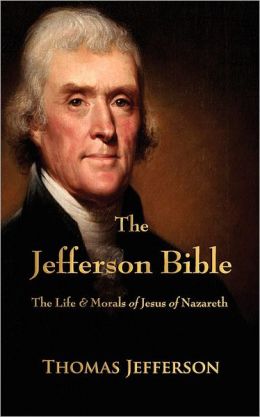
TheJeffersonBible

Jefferson’s Bible, 1820

In college, I discovered that one of my heroes, Thomas Jefferson, had done his own Jesuism as well. Verse by verse, with scissors and glue, he compiled eighty-two pages of New Testament writings about Jesus life and teachings that he found worth studying, verses he called The Life and Morals of Jesus of Nazareth (aka the “Jefferson Bible“). He characterized this effort as picking out “diamonds in a dunghill”, and encouraged each of us to do the same, with everything that is held up to us as scripture, by anyone.

As for me, beyond religious naturalism, which was called deism in Jefferson’s day, and agnosticism, I haven’t yet found my ideal religious community. But I have found a community, the Unitarian Universalists (UU), that am willing to join and do my small part to reform. I’m looking for a community that primarily promotes scientific and philosophical understanding of the universe and our relation to it (“universal thinking”), unconditional love of the universe and all its creatures (“love and empathy”), and higher moral behavior, activism against moral deviance and deviants, who may need “tough love” (“moral activism”). It should have a large, cognitively- and skills-diverse community, doing good social works and activism, to maximize friendships and social support. Importantly, since neither the Left or Right have a monopoly on truth, the community should support a great diversity of political views, ideally all lightly held.

Unitarian Universalism (UU) - A Good (Not Yet Great) Secular Humanist and Reform Religious Community

Unitarian Universalism (UU) – A Good (Not Yet Great) Secular Humanist and Reform Religious Community

Fortunately, the UU’s have built a big tent that welcomes lapsed believers from all the world’s religious communities, as well as nontraditional spiritual communities like us secular humanists. Most admirably, UU Sunday Schools (“Spiritual Growth and Development”) aim to give children a basic fluency in and empathy with all the world’s religious beliefs, while primarily promoting humanism, democracy, civics, and (to some degree) truth-seeking. There are still quite a few Liberal Christians, other scripture-believers, antiscience New Age thinkers, postmodernists, and woke activists in UU congregations, and thus not enough emphasis yet on science, evidence, and rationality in their spiritual practice. But all UU congregations champion gender, racial, social, economic, religious and intellectual diversity and equity, and all have a growing secular humanist core.

Predictably, the largest UU churches have formed in cities that have old and large universities. A lot of worldly and educated people choose these churches as their spiritual communities. I still cringe at the way UU churches use old Christian terms, like “worship” instead of more accurate terms like “fellowship”, and I find some UU congregations growing too politically liberal in recent years, with some ministers advocating utopian ideas like open borders, defunding our military and police, and other forms of woke thinking. But I am confident that as evidence accumulates, and AI advances, these exceptions will die away, and we’ll see a more balanced set of liberal and conservative values and language in their leaders.

Jefferson dabbled in Unitarianism before deciding it was too faith-based. But since the merger of Unitarians with Universalists in the 1960s, when it actively embraced the secular humanists too, it has undergone a lot of reform. UUs also continue to revisit their main beliefs in a democratic way. Science and evidence-seeking is just one strand in their presently beliefs, and sadly, in recent years, this strand has become less important and explicit. Many UUs don’t even believe that there are universal values, common to all cultures, or that a developing a better science of values and ethics should be one of our primary goals, as humans. But as AI continues its accelerating advances, and as we all get personal AIs in coming years, I predict that in thirty years, the UU community will be much more rational and scientifically centered than it is today. It will be the a lot closer to ideal that Jefferson was (and I am) still searching for.

Other good-sized groups seeking to advance spirituality in a secular age are the Humanist, Ethical Culture, Society of Friends (Quaker) and various Freethought communities. I’d recommend checking any of these out now and attending any that are helpful to your own spiritual path. But while Freethought, and to a lesser extent, the other spiritual communities above recognize the primacy of science as way of knowing, all of these still miss the importance of the phenomenon of accelerating change to the human condition. Few today are going to talk about the coming of artificial general intelligence (AGI) and about what kind of AI we want to create in the world.
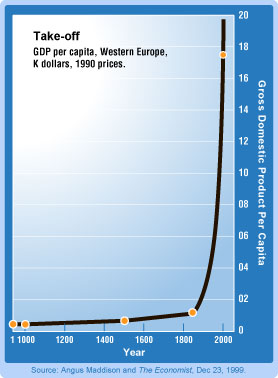
GDP Per Capita for Western Europe, 1000 to 1999 CE. Global wealth continually accelerates, as does information production, computing, communications, and nanotech advances. This continual acceleration of special processes is the most interesting and civilization-advancing phenomenon in the Universe, and we don't yet know why it exists.

The continual acceleration of certain resource-minimizing processes is the most interesting and civilization-advancing phenomenon in the history of life on Earth, and presumably on all other Earth-like planets. Yet we don’t study its physical basis, or know what function it serves.

One of the greatest conceptual oversights of all of these communities, in my view, is that none of them are discussing, writing about, or contributing to research on apparently innate developmental trends toward increasing universal complexity, morality, and consciousness, what the Jesuit priest and paleontologist Teilhard de Chardin was discussing eloquently in the early and mid twentieth century.

Given these apparently natural developmental processes, it is obvious to me at least, that we will see a far faster, smarter, more capable, and more resource-independent (catastrophe-immune) postbiological intelligence very soon on Earth. So for me, what intelligent technology wants, and how we can best guide its its emergent goals and morality, are among the most interesting practical and spiritual questions of our age.

I am doing my small part to help our local UU’s think, talk, and do their own research on such questions. I hope you can do the same in your spiritual community, and if you don’t have one, I welcome you to try out UUs. You can bring your whole self to the UU community, expose your kids to big moral topics and questions, and struggle with others as well all strive to live with greater truth, beauty, and goodness. Walking a spiritual path with others who are science-oriented and evidence-based, and serious about living higher values, is far more effective and rewarding than doing it alone.

What Will Disappear by 2030? An Intro to Global English

Cindy Wagner, the future-savvy editor at The Futurist magazine is running a new feature, Disappearing Futures: What Won’t Be Around in 2030? Here are three things I proposed will greatly or entirely disappear over this timeframe: Endangered Languages, Economic Immigration Barriers, and Mass Fundamentalist Religious Intolerance. In the process I introduce an imminent planetary development that I’m particularly excited about: Global English. Agree or disagree? Let me know in the comments, thanks.

The leading language learning software on the planet. Waiting to be knocked off its pedestal by something entirely free and crowdsourced, like Wikipedia.

The leading language learning software on the planet. Soon to be disrupted by crowdlearning platforms like Duolingo, Memrise, etc.

True Wearable wristphone concept, 2007. Someone make this now. Please.

Wearable wristphone concept, 2007. Coming circa 2015.

By 2020, the ubiquity and affordability of wearable smartphones (Google glass, wristphones, etc), and the power of the conversational interface (Google Now, etc.) will give enterprising youth everywhere access to “teacherless education,” lifelong learning by conversation, both with remote peers and with the web itself. For kids in developing nations, the killer app of teacherless education will be learning a developed nations language while learning their own, increasingly from birth. Their wearable will “listen in” as they learn their native language and deliver the same words in the foreign language of choice, along with images, learning aids, and games that test proficiency. They can of course let their system post their developed world language skill level on global networking, recruiting, and microwork platforms (LinkedIn, oDesk, etc.), opening themselves up to new collaboration opportunities.

Imagine a Rosetta Stone that’s 24/7, free, wearable, conversational, and driven by crowdlearning, and you’re seeing what I call Global English. Check out Duolingo, a new crowdlearning platform for language learning and translation, and Memrise, a new platform for learning anything by crowdsourced memnonics, spaced repetition, and adaptive testing, and you’ll see two exciting examples of how the wearable web, learning science, and millions of connected people will bring us Global English in just a few more years.

Of the roughly 6,000 languages spoken today, perhaps 4,000 of the endangered languages will no longer be spoken by children in 2030 (making them “moribund”), and perhaps 90% of the remaining 2,000 will have lost users as well, as the languages of developed nations with the most open cultures increasingly take their place. While we mourn the loss of endangered languages and the minds that speak them, what matters most is ensuring that their cultural history, values, and semantic complexity are captured in the languages we continue to speak. We’ll also see many more scientific, technical, business, social, and artistic “languages” (knowledge systems, like coding) increasingly taught from birth with these amazing learning systems.

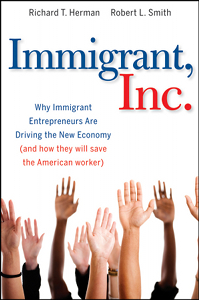
Good book on the underrecognized value of merit-driven immigration to economic and cultural wealth. It has been and always will be so.

A mix of merit-based and humanitarian immigration has always been a key driver of economic and cultural wealth. Politicos may not want it, but the internet will accelerate global virtual immigration.

English, the global language of business today, and a language much easier to learn than Chinese, it’s closest competitor, will definitely benefit most, with Global English platforms bringing English-speaking nations as many as 1 billion new “virtual immigrants” by 2030. Though most of these will still be kids under 18 in 2030, the wearable web and Global English may grow the total potential English-language workforce on the order of 30-50% in two decades, a growth rate we haven’t seen since Industrial Revolution-era immigration to the US and UK. At the same time, in the high-bandwidth 2020’s, many economic barriers to participating in the global economy will disappear. Eager underemployed youth anywhere, speaking the same language and increasingly understanding the same global culture, will be able to work with large and small companies everywhere, vastly accelerating global innovation and entrepreneurship in the 2030’s and beyond. That will be an amazing time.

While most youth and adults will use wearable machine translation for any contact with outside cultures, such mediated systems will never be as fast or fluid as knowing the foreign language itself, and the “death of language learning” predicted by some futurists by the 2030’s won’t occur. Instead we’ll see growth in foreign language learning at some threshold of marginal opportunity and native speaker number (perhaps 5o million?), and rapid growth in a handful of the most influential global languages, and in particular, English. Companies like Open English are already using the web to accelerate English-language learning today with $1000, yearlong, four-person online classes with proficiency guarantees. Imagine what will happen when this price drops to free, as with Duolingo and Memrise, the learning is 24/7, and the AI and crowdlearning tools get really good.

A key motivation to consider is how the parents who push their children to learn a leading foreign language (or two) will give those children both measurably greater economic opportunities and I believe, provably greater collaborative and cognitive fluencies, since learning a foreign language and getting immersion experiences in that culture, even digitally, allows you to better think in, work with, and understand that culture. Although there are as yet no good measures for the semantic size of vocabularies in our languages, (a topic we care about, unlike R.L.G.’s conclusion in the post I’ve linked to) it is well known that leading languages have by far the largest semantic vocabularies by comparison to languages spoken by just a few hundred thousand people. English is often claimed to have a special place in this regard, having absorbed so many words and concepts from other cultures, and with deep technical vocabularies, that some estimate that it has over 1 million words now. Of all the knowledge bases one could easily learn at birth, choice of language(s) seems key. Linguists and cognitive psychologists have argued for decades that language influences thought. What we can all agree on is that semantic complexity influences thought, and that some languages have much more of it than others. It is also true that learning just a tiny percentage (perhaps 2%?) of the words in most languages can give you basic fluency in that language, and we can expect to see a lot more of this kind of polyglot learning of languages in the future.

One day, when we hit the tech singularity (which I’m guessing will be in the 2060’s, and it’s just a guess because acceleration studies doesn’t exist yet as a funded field, we have some waking up still to do) I imagine the AIs will create, and teach us all, a new global language that is a semantic mashup of all the best of our global cultures, even more than our mongrel English, and with a structure that is grammatically easier and phonetically far more efficient (perhaps by using all 100 phonemes we use across all cultures, instead of just the 20 or so in a typical language) than anything that exists today. An Esperanto for the late 21st century. But until that time arrives, what seems obvious to me is that English, the most widely taught foreign language today, will continue to win as the collaboration language of choice in coming decades, just as cities will continue to win over rural areas.  And those who speak in any language will have a much richer ability to interact with all others who use that language.

CoexistIsraelPalestineNow for perhaps the most controversial prediction. As long as global science, technology, free trade, and wealth continue to accelerate, as I expect they will, and our resilience to catastrophes of all types continues to grow, all the major religions and ideologies will grow more ecumenical and secular as well. Mass fundamentalist religious intolerance, still a serious issue today (Islamists of the West, Hindus of Dalits, Christians of gays, etc.) will be decimated in the ambiently intelligent, hyperconnected world of 2030. Specifically, fundamentalist religious movements ability to use economic or other catastrophes to roll back social reforms at national levels, will have disappeared for good, in any nation.  Consider the Iranian Revolution in 1979, where mass religious fundamentalism, reacting to the “catastrophes” of corrupt governance and reckless modernization, rolled back personal freedoms and social development perhaps a century or so.

In the wearable web world, political activism will surely be accelerated, but it will also be far more transparent and accountable to public sentiment. Tolerance for both mass and individual intolerance and extremism will go out the window, as the costs of extreme and intolerant views and behaviors will be delivered not only to our televisions, as occurred in the Vietnam War in 1960’s US, but to our bodies, everywhere and continously. Political and religious fundamentalist backlashes within subcultures will always be with us, but we can expect (and hope) they’ll be far more circumscribed, weak, and short-lived. We can predict that as long as sci-tech accelerations continue, Global Gen Z youth, interacting socially with an intimacy and concurrency that we can only dream of today, will overwhelmingly see mass fundamentalist intolerance as extremist, arrogant, and counterproductive.

Still don’t believe the third prediction? Read Pinker’s The Better Angels of Our Nature: Why Violence Has Declined, 2012, for a masterful expose of this global megatrend.  Amen!

About the Author: John M. Smart is a technology foresight scholar, educator, speaker, and consultant. President, Acceleration Studies Foundation. Blog: http://EverSmarterWorld.com

Keep Calm and Carry On – Reacting to the Boston Marathon Bombing

Runners continue to run towards the finish line as an explosion erupts at the finish line of the Boston MarathonI’ve had some deep discussions today about the Boston Marathon bombings with friends. Here’s something I shared with a friend who lives in the Boston area in Massachusetts. His predominant feeling right now is disillusionment. If you’re in the same boat, I hope you find it helpful in some way. Thanks for any feedback.

Friend, I hope this event won’t shake your faith in humanity or in the continued acceleration of global progress, or in our ability to better understand what progress is, and for reasons yet to be discovered, why accelerating progress seems only partly under our control, and partly driven by the amazingly intelligent and self-correcting environment into which we were born.

acooperativespecies2011There are always half of one percent of us who are seriously broken in some way. It is surprising, when you stop to think about it, that majority of us are so strongly against doing such cowardly and terrible things. Almost all violence is rapidly self-limiting. It can be a calculation of fairness, a seeking of justice in the wild. Or a case of beliefs being seriously out of step with reality, or emotions not being sufficiently regulated. Fortunately, for the vast majority of us, our moral sentiments and desire to cooperate are incredibly deep, selected and self-organized over countless previous life cycles. At the same time, our tools and policies for protecting the world system get only better and smarter. We must understand these processes better, and aggressively work to improve them in society and the individual.

the.transparent.society1998The mentally ill, extremists and oligarchs throughout history are a persistently tiny fraction of society. The main effect of mental illness events like this (these particular bombings, irrational as they are, are even more a mental and psychological illness than an extremist/terrorist event, as I see it), aside from their tragic short-term cost, is to grow our global immunity to them in future years. If we learn from them (a critical “if”), they accelerate the emergence of the transparency tools and social development programs that we know is our future, and as long as it is increasingly a bottom-up, citizen-driven transparency and social development process, we gain greater control over both the extremists and the autocrats, our democracy strengthens, and the world gets collectively more intelligent. Imagine, as social and media futurist Alvis Brigis says, if it was ten years in the future and one out of twenty people in that Boston crowd had been wearing Google Glass or an equivalent? (I’m a Glass Explorer, so I’m looking forward to getting an early adopter version of this fantastic new wearable computer and lifelogging tech). They’d all be able to share their recent archives and feeds and it wouldn’t be long before we’d have the perpetrators identities and last public locations.

Mental illness is one issue, but what about oligarchy (government by elites, without representation) and plutocracy (government by the wealthy), and the way such governments breed extremism in the developing world by replacing culture with commercialism, removing self-determination and representation, and inducing cornered cultures to react with Fundamentalism? If increasing political, economic, and social fairness is a clear vector of social progress, how do we keep building it in all our societies in the years ahead?

With regard to the plutocrats, there is good news: our global rich poor divide has never been smaller. It was highest in the 13th century  under Feudalism by several measures, and has slowly decreased ever since. But the problem we face is that in the world’s leading and fastest developing countries inequality seesaws, at first going up as the wealth of new technology revolutions is initially captured by the well-capitalized few, and then later down again as the revolution works its way out to the many, where the maturing and cheapening tech allows disruptive new entrepreneurship on top of the platform, and as new rights and entitlements eventually emerge.

priceofinequalitybestcover1

The Finland Phenomenon, a great film on the education reform the US needs for more self-reliant and less fearful citizens.

The Finland Phenomenon, a great film on the education reform the US needs to make more self-reliant, innovative, and less fearful citizens.

As Joseph Stiglitz discusses in The Price of Inequality, 2013, we need a certain amount of income inequality to spur innovation, but if we let it get too big, the wealthy and the corporations capture our political machinery, only their interests are represented, and democracy, political reform, and political compromise and moderation die. Due to tech globalization’s great wealth creation, income inequality has grown rapidly in the last 60 years in a handful of nations, in the 1970’s-80’s in the US, UK, and Israel, and in the 1990’s and 2000’s also in rapidly developing countries like China and Brazil (and to a much lower degree, in a few low-inequality countries like Germany and Sweden). In the U.S., asset inequality is now so extreme that just 1% of us own 40% of the nation’s wealth. When our lower and middle classes can no longer find meaningful jobs under constant technological change, while we see other developed nations doing far better with education and job creation, we should not be surprised. We let this happen, by letting our MNCs get larger than governments (instead of splitting them up, as we used to), and by dismantling progressive income and inheritance tax for the wealthy (which last existed seriously in the US in the 1950’s).

To bring this back to the theme of this post, another big price of plutocracy is that our citizens lose the ability to engage with the developing world an empathic and positive-sum way, and our fear grows. We fear technological progress, as the job disruption dumps us into a degraded society that doesn’t keep job creation and retraining as the top priority. We fear the further loss of jobs via outsourcing. We fear immigration, and forget that merit-based immigration is one of the fastest creators of new jobs, science, and industries. We fear other belief systems, and we demonize the other, rather than finding common cause with the moderates in every religion and group. As our political system gets captured by unresponsive and polarized elites (they are wealth driven and fight hard to divide the spoils among themselves), tough social problems like educational reform don’t get done. See The Finland Phenomenon for an excellent example of what we can will one day do to fix our broken educational system, when we finally get the political will. In the meantime, our citizens grow increasingly globally ignorant, inward-focused, and politically apathetic, or polarized and uncompromising like their wealthy masters.

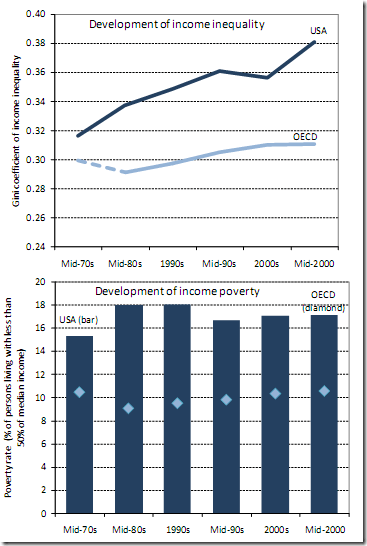
Source: Growing Unequal?, OECD 2008. <BR> Click the graphic for the report.

Source: Growing Unequal?, OECD 2008.
Click the graphic for the report.

But, thank the Universe, America is an outlier, with our elites capturing such an outsized portion of the new technological wealth in the last six decades that we are going temporarily against the global trend. We will eventually reverse this and be forced, by accelerating technoeconomic integration, to get back to the global trend. The developed OCED countries as a whole aren’t following our sad course of sixty years of rapidly increasing income inequality and 60% higher levels of income poverty, as the 2008 OECD graphic at right shows. Remember that for the global economy, the absolute size of the inequity gap is still closing since Feudalism. As visionary books like Abundance, 2012, make clear, we can see how extreme global economic and educational poverty will disappear just a few decades hence.  Many of the emerging nations are now in the process of growing their GDP two or three times faster than us. Check out Gapminder.org for some beautiful graphs telling that story. If we’re thinking at all about accelerating tech, we can see a new world of the conversational interface and of teacherless education (to use futurist Thomas Frey’s great phrase) less than ten years hence, where every literate and illiterate child has a wearable waterproof smartphone on their wrist, listening in to what they are learning and teaching them who knows what.

Accelerating technology always causes evolutionary disruption in the first phase. More money goes to the rich and the leading corporations, at first, rather than the rest of society from any new technological and trade revolution, be it industrial, transportation, mass consumption, communications, personal computing, internet, web services, or any other revolution affecting the global marketplace. In the U.S. and a few other countries, these and other revolutions have been the dominant story of the latest 60 years of globalization. In turn, the vast new wealth increase of the MNCs, many of whom now have revenues larger than those of the leading countries, and their unrestrained effects on the developing world, has been a great driver of the clash of cultures and the extremist events we see today. We are pushing citizens in many of these cultures to change at a rate far faster than their reformists are comfortable with, and successive waves of technology innovation are driving them (and us, but always to a far lesser degree) continually out of their livelihoods into a globally wealthier but, in the absence of good retraining and social safety nets, a much more socially uncertain future.

virtuous_circleantifragileEventually the global system, being not only evolutionary but also developmental, always gains irreversible new levels of total positive-sum integration, and immunity. For the system as a whole, virtuous cycles are always underway and antifragility will increasingly dominate, if global development is like living systems development, as I believe it is. I hope you can find a way to see and guide the positive changes that will come from this tragic event, as they surely must.

Bruce Schneier, Security Maven

Bruce Schneier, Security Maven

So regarding our emotions and actions around this bombing, with a potential to cause disproportionate fear and immune response, as occurred after 9/11, I think Bruce Schneier’s brief piece in The Atlantic says it best: Keep Calm and Carry On.” Let’s not overreact, overspend, overregulate. Let’s not fixate on or overgeneralize this rare event itself, or get scared. Let’s continue to work calmly on the social development processes (income equity, representation, education, psych services, job creation, civics, religious tolerance and reform) that will reduce the probability of this happening again, and the transparency processes (primarily bottom up, and secondarily top down cameras, sensors, networks, databases, pattern recognizers, human intelligence) that will increase our ability to find, isolate, and help (or at least, prevent from further harm) the broken folks or individual who did this.

Let’s implement our actions carefully and incrementally, while always insuring their social benefits exceed their costs. Let’s keep calm and carry on.