Heathrow Has No Wifi Clothes, It’s Gone Boingo

Heathrow, airport of the 2012 Olympics. No affordable internet access.

It’s high time for another post to the Deviants section of the blog, so let’s get started. Like cockroaches under a rock, Deviants frequently come in packs. Find a problem, dig deeper, and you often discover a bundle.

This time we’ve got at least four deviants to offer you. Let’s start with Heathrow International Airport, bane of international travelers (To remember how bad they are, it would be great if we could “heave and throw” them out of the global airport hub system till they up their game)

At Heathrow, wi-fi costs over $25 (US equivalent) for a “day pass”. No hourly rate is available. This Machiavellian strategy screws thousands of short-layover people every day out of any access to the internet.

From http://www.ihateboingo.com Logo and running man should be reversed, to show customers fleeing, I think. Any graphic designers want to update this pic?

The wi-fi is run by Boingo Wireless, one of the largest and horriblest (yup, that’s a word) wireless companies presently inhabiting our precious island Earth. Check out Boingo’s atrocious reviews at CNet. They’ve been regularly accused of several deceptive practices, including repetitive billing when customers sign up for a day pass, and terrible procedures for getting off their repetitive billing. See more lovely complaints by the downtrodden here. Boingo has an apparent, if not a legal monopoly, on wi-fi at Heathrow. I wasn’t able to find anything else when I was recently there. The information desk didn’t know of others either. (Were you waiting for a way to remember Boingo as a deviant? Think of getting boinked economically, in a coercive manner, and you’re pretty close.)

Heathrow is designated as a hub airport in the global travel system. By choosing Boingo, the UK is screwing all international flyers, telling them what they really think of them and their travel dollars. It would be lovely if the ICAO or another governing body for airports could hold them accountable on this. Heathrow’s general level of service is has long been rated poorly (see the large number of low ratings at Skytrax buried among the positive ones, some of which I suspect are pre-Olympics PR shills). Heathrow’s run by BAA (think black sheep to remember them) the plutocratic, bureaucratic airport management conglomerate that until recently had a monopoly on all the main London airports for years. In 2009, the UK government finally forced divestiture of the two other London airports also owned by BAA. Big money here, so things are slow to change.

Free wireless now exists in hundreds of civilized airports globally. See: http://www.wififreespot.com/airport.html for a list. Apparently T-Mobile (only slightly less sucky than Boingo) was in Heathrow before them. And apparently the Starbucks in one of the Terminals at Heathrow had good cheap connectivity way back in 2006. It’s not rocket science.

Anticompetitive industry lobbying groups like the CTIA (formerly called the Cellular Telephone Industries Assn, but you can call them Controlling Today’s Information Access) push for airport monopolies on wifi service provision, as they did in 2006 at Logan Airport in Boston, for example. That sucks.

It’s high time to recognize wi-fi access to the internet is no longer a luxury good, but a community service that should be free in all civilized countries, like bathrooms. Soon it will be a right, like 1Mbps internet is in Finland.

How do we get free wi-fi as the base layer in all our airports over the next few years, including the largest, most plutocratic and bureaucratic ones like Heathrow and LAX? For a start, I recommend complaining to Heathrow on Twitter, @HeathrowAirport, and using the tag #HeathrowAirport. Anyone searching the tag will forever see your thoughts about their crappy wifi, and can add their voice. You can also complain here on their website, but that’s private. I’d trust BAA/Heathrow’s willingness to do anything with your private feedback as far as I’d trust a scorpion not to sting me.

Until your cybertwin can relay your opinion to the web for you on voice command, for all of us to use to guide us to the best things, and to help us rein in the deviants, take a moment and let them know what you think. If you have any other good strategies in mind, let us know in the comments, thanks!


Bob Frank on Darwinian Econ, and a Call for Backbone in Obama’s 2nd Term

Bob Frank, Professor of Management and Economics at Cornell, is brilliant at framing economics in evolutionary terms. Visit his home page for some great articles, videos, NPR interviews, and books, if you want a quick tutorial in common sense economics.

His new book, The Darwin Economy, is an elegant argument for why rising economic inequality hurts any economy, and why evolutionary competition always must be balanced against developmental cooperation. The Spirit Level, The Fair SocietyThe Impact of InequalityThe Great Divergence, and Wealth and Democracy are other highly recommended books in this vein.

To start,  we must recognize that certain levels of income and asset inequality are incentivizing and proinnovative. Think for example of the levels we see in Germany, Scandinavia, and other social democracies with innovative, healthly small business and strong industrial bases.

But if you don’t have a state that understands its critical role in limiting the income and asset divides via appropriate levels of income and estate taxation, they grow until they become counterinnovative. Cartels and collusions and special interest lobbying take over, incentives for inter-class cooperation are destroyed, and real bottom-up competition disappears. The folks at the top gain the economic means to change the rules to benefit just themselves, and the economy becomes a nepotistic kleptocracy, as seen in the kind of capitalism in autocratic states like Russia. Or the way Israeli capitalism is being captured by a few uberwealthy families in almost all the major industries (some areas of infotech a current exception). Marginal U.S. income tax rates over $2 million/year were 90% in Eisenhower’s term, and they are effectively 15-20% today, to our great shame. We’ve got a long way to go to get our house back in order.

Frank makes clear the unclaimed potential of an evidence-based bipartisanship emerging in coming years, and the real value of both liberal and conservative ideologies, policies, and rulesets in a capitalist social democracy. He also discusses the dangers of taking both right (libertarian) and left wing (nanny state) views too far, of giving either camp too much rope to hang themselves with.

Here’s a nice USA Today op-ed between liberal Frank and the conservative P.J. O’Rourke on how Liberals and Conservatives can get bipartisan agreement on infrastructure spending in a depression, and should avoid proposing visionary projects, which are anathema to each other. This has some merit to it, and I’d be excited about it if they were talking not about roads, which are of real but ever-declining relative value in a world of accelerating tech, but about digital infrastructure, as that is the greatest bottleneck holding back all kinds of new technical productivity in this country, as Yochai Benkler’s The Wealth of Networks (free PDF version) and other books eloquently describe.

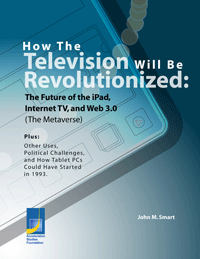
The harsh reality is that big business, particularly big media and telcos, have always been able to derail fast-track digital infrastructure building, as it will of necessity disrupt their business models. Read my whitepaper, How the Television Will be Revolutionized, if you want some of the grim details on how big business has thwarted the arrival of real broadband for American citizens, and will continue to do so until we have political leadership with vision and backbone.

What we need is a President who recognizes that government must place the needs of society above the needs of big business, for key decisions. Obama felt he was that president, but he fatally decided that health care, rather than digital infrastructure, would be his first key play for reform. In a major recession no less. But health care reform won’t create the jobs we need, only a special combination of digital infrastructure reform, immigration reform, small business support reform, regulatory and tax reform, educational reform, and a few other key reforms will. Just as Keynesians know the state needs to save in a boom and spend in a recession, they should know you don’t do health care reform in a recession, but in a boom, or on the way out of one. By going up against the wrong big businesses for the time, and focusing first on health care over “jobs, jobs, jobs,” he crippled his political capital, and screwed up any chance of a productive jobs-oriented bipartisan alliance emerging on the hill for years to come.

The only reason it’s 60% likely he’ll get another term, as the useful prediction market Intrade will tell you, is because the other choice is no better, so we’ll stay with the incumbent. (Dear reader, I hope you are paying as little attention the U.S. presidential election circus as I am these days, as there’s far better things you can do with your precious time). Obama advisors, please read my post on The Race to Inner Space. What matters in tech policy if you want to accelerate national productivity in your second term is driving innovation in nanotech and infotech first, and every other technology (including health care, which already takes up a staggering 18+% of our GDP) second. Until we have a president who realizes this, our tech policy will continue to be unenlightened.

Fortunately, the smarter the web gets, and the smarter our circa-2020 AI assistants (cybertwins) become, the closer we’ll get to seeing the emergence of an evidence-based bipartisanship, and a plethora of evidence-based policies that advance our technical and human productivity. We may have to wait a decade to see meaningful political change, but oh what a decade of scientific and technical advance this one will be. I can’t wait.

Ten Reasons the 99% Should Care About Internet Television

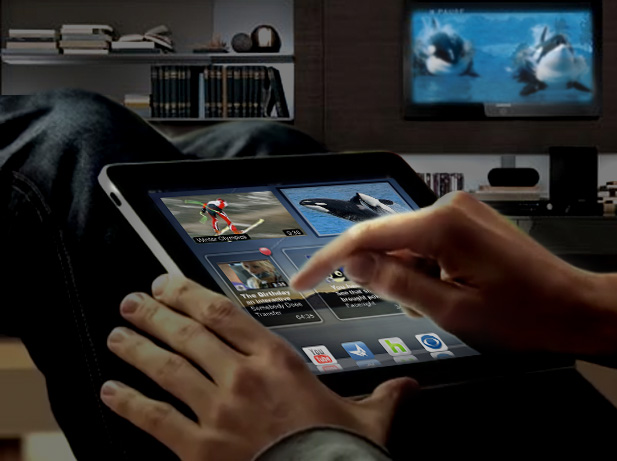
Vision for an iTV Remote: Tablets, laptops, and smartphones turn into TV remotes. Manage thousands of your favorite specialty videos and channels, all from your lap. Each viewer has their own second screen, for social viewing, chat, feedback, ratings, rankings, suggesting what to watch next, games, etc. A serious entertainment and education platform. (Artist: M. Rojas, Fizbit.com)

Big cable and telco companies, in bed with captured legislatures, are actively slowing down the arrival of iTV in the US, Australia, and several other industrialized countries dominated by Big Media today. These deviants are trying to keep our internet bandwidth below 100Mbps for as long as they can, because around that number, TV-quality internet streaming video platforms can emerge, platforms with millions of channels, and which use much more clever and lower cost methods (highly personalized and localized commercials, subscriptions, micropayments, AdSense, etc.) of monetizing custom video content. iTV will take away Big Media’s monopoly of the living room screen, and will massively fractionate their TV advertising market. It will also create an environment that will support hundreds of thousands of new, independent, full-time specialty video producers, remixers, and commentators, and facilitate massive new entertainment and nonfiction (education, documentary, civic engagement) video subculture emergence. This is something the 99% can get very excited about.

Unfortunately, US consumers so far have been slow to adopt any form of “lean forward” television, where they have to occasionally lean forward in their chairs to search for content using the keyboard. Google TV adoption, for example, even though it is a relatively inexpensive move away from the closed telco set-top box,  has been a lot slower than some expected. Logitech lost $100M on their Revue box for Google TV in 2010, and have announced they’ll be pulling out. They made far too many of them, and learned that the consumer is far less interested in messing with yet another incrementally useful household gadget than they anticipated. I really like my Revue, it has served us well all year, and Logitech could have built some good will by serving its small customer base a lot better this year, and teaming up with Best Buy or another electronics retailer to work out installation deals to get them into more houses. But I’m in that 3% of Americans (and rapidly rising) who watch TV shows online but don’t have cable, often on principle. Had Logitech focused on us, the best market for Google TV at present, they’d have found a willing audience. No matter, LG Electronics and other hardware makers will step in for the next version of Google TV, which will only get better faster, now that a new Apple TV is in the works for 2012. Consumers are waiting for better “lean back” experiences, where the platform will automagically decide what they are interested in, and feed it to them, and they can occasionally give feedback to it, preferably by voice. They’re waiting for Xbox and Apple to wow them with something totally simple and easy to use. This will happen, but it will also be something that is quite closed. Not as bad as the cable companies present offerings, but not nearly as open as the web. What we can continue to expect from the big corps, excepting the few, like Google, whose business model revolves around openness, will be more bread and circuses, while the media plutocrats keep the system rigged in their favor, and the little guy keeps getting shut out of the living room video marketplace, and 21st century social diversity, specialization, collective intelligence, and democracy continue to suffer.

How do we help the tech literate, discriminating consumer, the 20% who are opinion leaders, see that the current Big Media-run TV universe, with $60B of annual TV advertising in the US alone, and endlessly repetitive ads for far too many crappy products, is going to inevitably be remade into something that is far more customized and relevant to each of us? How do we get them to see the value of TVs that have both amazing lean forward features (even if only occasionally used) and very intelligent lean back features, and that are truly open video marketplaces? How do we accelerate the irreversible developmental move to a platform where lots of money flows not only to studios, but also to hundreds of thousands of small company specialty video producers, and where ads become so diverse and specialized and local and context sensitive that they aren’t ads, but education? Once the bandwidth arrives, I expect (and hope) that better and far more open iTV platforms will be built, and people, starting with the youth, will migrate to them in droves. Big Media will likely still get 80% of the revenue, and provide 20% of the “fat head” of the distribution. But we’ll also have lots of Little Media, getting 20% of the revenue, and delivering 80% of the variety, the “long tail” of diversity on the video web.  And we’ll have a different kind of Big Media, corps that have adapted to a more service-oriented model, or died.  The world will be a much smarter (and more entertaining) place.

Here are ten reasons to get excited about the near future (circa 2020?) promise of iTV. In the meantime, I hope they help you become an early adopter of the most open access, true internet television you can get:

  1. 1 million+ specialty video channels on your TV. A worthy video platform for a 21st century democracy.
  2. Americans spend half their free time watching TV. They need much better and more specialized news, entertainment, and education.
  3. We all need the ability to like, dislike, and ban any types of ads that come into our home that we don’t want. Only ads you care about will be allowed into your home. Finally.
  4. Our tablets, smartphones, and laptops will become our iTV remotes, and our game controllers for amazing new iTV games.
  5. Social viewing, chat, and collaboratively filtered recommendations will be central to the best open platforms. Facebook, Google+, Twitter, etc. will help us find good content.
  6. We need user-customized commercials, with half-muting, or full muting with captions, of whatever duration we want (10, 12, 18 mins per hour, etc.). Watch more commercials, you automatically get access to more expensive, ad-supported content. Want to watch less ads? Pay a channel subscription, or micropayments for premium video.
  7. Realtime customized captions & sidebars. Never again watch news, or politician’s harangues, without great social commentary and analysis running in realtime in the side bar.
  8. Open source video licenses on video content will bring peer-to-peer, mashup culture to video, and greatly improve video content.
  9. If copyright holders offer a rental license to anyone, they must also offer a remix license, priced no higher than the rental license. This is law in some states, based on the editing licenses that Hollywood sells for edited versions of movies that play on TV, in airplanes, etc. This needs to become federal law, to empower global remix and editing culture.
  10. It’s time for a hundred competing specialty channels of [your interest here] TV!
Action Items: Share this post around, if you agree with it. Critique/improve it where you don’t. Be an early and preferential adopter of Google TV, Boxee, (Amazon?) and any of the most open, most citizen-empowering video platforms to come, run by companies or startups that are the most dedicated to open web access and open media empowerment. Choose these over XBox, Apple TV, and other more closed, yet often prettier platforms, both now and in their better versions to come. Use BitTorrent, BinTube, or other peer to peer video sharing solutions aggressively, to force big telcos and cable to upgrade their crappy networks. Push digital pigs through their tiny pipes. Seed and share open source and creative commons video content. Donate to and support the Open Video Alliance, openvideoalliance.org

For more, see my:

• 20 min video, The Television Will Be Revolutionized, TEDx Del Mar, 2010.

• 2-page summary, How the Television Will be Revolutionized, Accelerating.org

• 4-page article, Tomorrow’s Interactive Television, The Futurist, Nov-Dec 2010

• 48-page whitepaper, How The Television Will be Revolutionized, 2010.

  Thoughts? Comments? Let me know, thanks. [tweetmeme source=”johnmsmart” only_single=false]