 Those interested in Life Extension may enjoy this $3 TED eBook, When I’m 164: The New Science of Radical Life Extension, by David Ewing Duncan. [If you purchase on Amazon, consider taking delivery to your Kindle Cloud Reader, and reading it in your browser with the Kindle Chrome extension. The highlighting and notes features work decently there now.] Duncan notes that global life expectancy was just 31 in 1900, and has doubled to 65 today. In America, it’s near 80. In Monaco, it’s now 89. In Swaziland its still an inexcusable 32. When I’m 164 attempts to consider what the world would be like if our average lifespans moved a long way toward doubling yet again. It’s a well written and insightful read and I recommend it, but I also found a few areas where it fell short. I hope you agree and if not, please let me know in the comments.
1. Killing the Myth of Overpopulation
Any book on radical life extension should do its part to kill the persistent overpopulation myth we hear so commonly in our mass media. The longer this myth persists, the more shoddy thinking we’ll see in the public about the future. Human population growth was increasingly rapid until the early 1960′s, when it hit an inflection point, and the rate of growth has been saturating ever since. Population growth is now in a phase of rapid collapse. Folks love to argue about whether our accelerating population growth and industrialization up to 1960 were on balance good for our species and the planet. I think it was tremendously net good, and that having more potentially bright and hard working people on Earth was our most important planetary resource in the 20th century, as economist Julian Simon said so eloquently in Ultimate Resource in 1983 and again in Ultimate Resource 2 in 1998. I don’t believe having more human minds is the most important marginal resource today. But fortunately, neither does humanity. Population growth has been decelerating ever since 1962, and absolute numbers of people on the planet will soon go negative. It is the numbers and abilities of our machines that are now growing exponentially. It’s time we acknowledge these obvious trends, and move beyond the myth.
Duncan notes that the global percentage of kids 5 and under was 15% in the 1960′s, and is under 7% today, and still declining. This great piece of data comes early in the book, but he doesn’t go nearly far enough in exploring or explaining its implications. As demographer Hans Rosling reminds us in his “Peak Child” presentations, the absolute number of humans being born annually, 135 million, peaked in 1990 and has been roughly constant ever since, and will soon be declining. Furthermore, the fraction of our global population that is under 18 is now 27%, and this fraction will never go up again, only downward, every year forward. We are no longer a Planet of the Young, as we were when kids were an insurance policy against disease and misfortune. Birth rates are dropping precipitously almost everywhere, and our average lifespans creep up a bit every year as well.
There are 7 billion humans on the planet today, and some project we’ll reach 8 billion by 2025. Circa 2000, the most credible reports had us maxing out at 10 billion by or before 2100. The United Nations now projects 9 billion by 2050, and 10 billion by 2100, and a “high case” possibility of 14 billion by 2100. Unfortunately, I believe UN estimates are systematically biased to overstate the problem. More credible to me, but still probably overstated, are reports of us maxing out at 9 billion by 2050, then steadily declining thereafter, as deaths increasingly outstrip new births. I agree with Peter Diamandis and Steven Kotler in their excellent Abundance, 2012, that we should plan for the possibility of 1 billion more souls arriving in Asia and 1 billion in Africa between now and 2050, for a rough total of two billion more people, but I expect we’ll see even less growth than this.
Global population growth collapse is occurring not because of ecodisasters or food or other resource shortages, which are perennially oversold to us by the doomsayers, but because of a predictable shift in human values as social development proceeds. As Ron Inglehart and Chris Welzel have long documented, societies are gaining increasing personal freedoms and increasing evidence-based decisionmaking, which in turn is decreasing social fundamentalism and giving women many more desirable options besides childraising. If technological advances are the primary drivers of this values shift, as I believe they are, and as Inglehart argued in The Silent Revolution, 1977, it is then an obvious prediction that this values shift will continue.
Max Singer, one of the founders of the Hudson Institute, noted in “The Population Surprise,” in The Atlantic Online in 1999:
In only the past twenty years or so world fertility has dropped by 1.5 births per woman. Such a degree of change, were it to occur again, would be enough to turn a long-term increase in world population of one percent a year into a long-term decrease of one percent a year.
Given these trends, I would presently bet that “Peak Human” will arrive circa 2040 with perhaps 8.3 billion of us, a significantly lower number than most demographers now expect. In other words, our population future is most likely something close to the UN’s “low fertility” forecast in the chart below, with just six billion of us around at the end of the century, a billion less than our present state.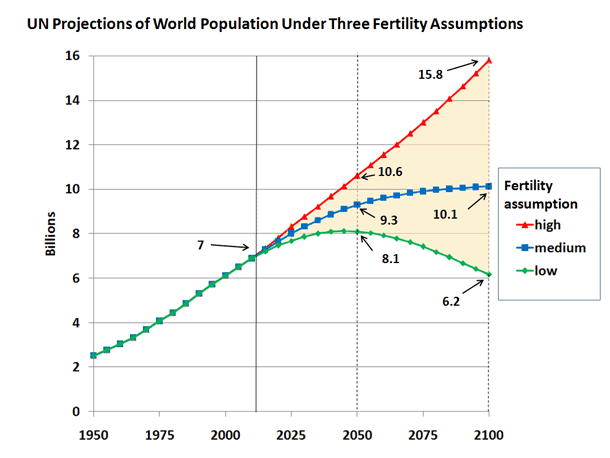
As we evaluate the likelihood of the low-fertility future, we must consider at least the following driving forces:
1. Society’s ever-increasing focus on sustainability as wealth grows,
2. The global web’s growing ability to quantify the negative environmental impacts of people,
3. The increasing social freedoms of women,
4. The decreasing marginal value of humans vs. machines to global productivity (see #2 below),
5. The inability to significantly extend average human lifespan before AI arrives (see #3 below),
6. Our likely growing lack of interest in remaining biological after AI arrives (see #4 below).
Consideration of these forces makes it very likely to me that global human population must shrink inexorably after we reach our peak. If true, our ascent and subsequent decline from the state of Peak Human should arrive a full generation before the technological singularity arrives, if the latter event happens circa 2060, as I would presently guess. To move beyond these guesses, we need more acceleration-aware (“accelaware”) forecasting, and more reference class forecasting to reduce the bias and deception in past population forecasts. Let’s hope this continues to happen.
2. Acknowledging Machine Productivity.
Duncan notes that one of the big social issues our governments will face in the future is funding our social security and health care, as these programs are ever more expensive and as the ratio of working youth vs. aging elders continues to decline. Health Care is now 17% of GDP in the US. This percentage will obviously only keep growing in the future, as medicine starts to actually work (remember it really didn’t, for centuries) and as more people want to live longer. In fact, growth in the health care industry as a fraction of GDP is one of the best indicators of our collective desire for longevity.
 What is unfortunately not mentioned at this point in the book is that working humans are less and less economically productive vs. machines in our Presingularity Era. As Erik Brynjolfsson and Andy McAfee describe in Race Against the Machine, 2012, people are increasingly going to be thrown out of work by ever more productive machines. So having more humans working is increasingly irrelevant to funding our future programs, as this recent excellent article by John Markoff, “Skilled Work Without the Worker,” NYT, 8.19.2012, reminds us. We want to give the existing humans the best jobs we can, and that will greatly stabilize our societies and improve human well being and happiness, but increasingly, those jobs won’t be of central importance to improving our planetary intelligence or capabilility. That role is rapidly moving to our machines.
We need to wake up and admit that the human exponentiation era is over. Biohumans are now in growth saturation, and will soon (circa 2040, just 28 years from now) be in permanent population decline. Our machines are just beginning their exponentiation phase, and we can expect trillions of physical and virtual machine intelligences on the increasingly miniaturized and evolvable hardware platforms of the near future. That’s good, because it is ever smarter and more efficient machines, not humans, that will most improve our precious social contract going forward. Let’s acknowledge and document this fact, so we can get better STEM education, entrepreneurship, funding, and policy going on in America now, not a decade from now.
Discussing how we will pay for all this health care and social security going forward, Duncan cites bioethicist Tom Murray, who states “It’s hard to see how we will be able to afford [health care for 120 year olds in the future] when we are struggling now to pay for people who live to be 80.” This would have been a great place to point out that the solution will happen in two ways. First, we’ll decide to reallocate more of our economy to health care. Our priorities will shift, driven by aging voters in all developed societies. Second, we’ll build a whole lot more smart machines, either now if we’re smart, or later if we’re dumb and unforesighted. Duncan reminds us that U.S. Social Security will be out of funds by 2033. That’s a good place to mention that robots will be driving our cars and wiping our ass for us on our toilets in 2030. Guess which of these two trends matters more. It’s the technical productivity and smartness of our machines that really matters. The rest is just politics.
3. Admitting the Difficulties of “Radical” Life Extension in Biology.
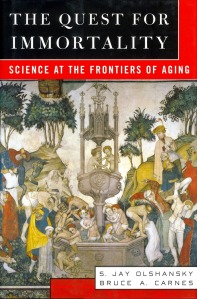 After many years of reporting on biotechnology, Duncan states: ”It’s unclear, however whether this [coming biotechnological] “fix” for aging will be a modest bump of perhaps 10 to 20 percent, or dramatic enough to take us to age 164 or beyond.” Duncan should read Jay Olshansky and Bruce Carnes’ The Quest for Immortality, 2002, one of many good books that clarifies just how difficult it will be for us to make aging interventions in human beings. Improving our lifespans by 10 or 20% over the next ten to twenty years is a very laudable and achievable goal. But anything significantly beyond that is simply fantasy, at least for the coming generation. With persistence, intellectual rigor, and a bit of luck will very likely discover a number of therapies that will bring impressive new longevity and wisdom to our species, adding ten, twenty, perhaps even thirty healthy years to the lifespans of those using them. It would be lovely and transformative to see more seasoned, pragmatic, and high-functioning 100 year olds operating in our social, economic, and political spheres, as my friend Sonia Arrison describes in 100 Plus, 2011.
But I can see no believable way mere human beings will develop therapies that push us significantly beyond our current maximum of 122 years of age. There are just too many independent ways that our molecular biology accumulates error and increasingly malfunctions with age. We fall apart at an accelerating rate from the inside out after we reach sexual maturity. All metazoans do this. I’m sure the AIs will eventually be able to figure out how to redesign our biochemistry and genetics to minimize error. But don’t expect humans to do this, it’s far too hard. The sooner we admit how difficult it is going to be for human-era medicine to push our lifespans much past 120, the sooner we can adjust our sights to achievable futures, and wake up to the fact that the universe is providing us with another option: moving our intelligence to machines.
4. Acknowledging the Advantages of Life in Silicon
This is tough stuff to discuss simply and seriously, as most audiences simply won’t believe it, but we’re already far enough into the machine era to point out the many advantages machines have over over biology in sensing, thinking, remembering, learning, adapting, self-improving, and resource efficiency. It’s most reasonable, when we are willing to overcome our humanocentric bias, to not expect more humans in the future, but rather the emergence of what Steven J. Dick calls a postbiological civilization. Duncan gives a brief nod to machine intelligence, uploading, and cryonics in his book, but he doesn’t mention chemical brain preservation or the Brain Preservation Foundation, the nonprofit I co-founded in 2010 with Ken Hayworth, to investigate whether the synaptic connections that store memories, personality, and identity in human brains can be reliably preserved at the end of life via either chemical preservation or cryopreservation.
 It’s too bad he didn’t cover our work. If either or both of these processes can be proven to preserve and retrieve long-term memories in well-studied neural circuits in model organisms such as worms, flies, slugs, and mice, we’ll have objective evidence that these technologies preserve neural information. The training, preserving, scanning, and successful reconstructing of critical elements of a model organism’s long-term memory might happen within this decade in fact, and steady progress is being made in the neurobiology and simulation of memory. We would then have a serious rationale for doing brain preservation for science, for memory donation to our kids or future society, or to achieve full identity reanimation in the postsingularity future, per the patient’s preference. Most interestingly, if chemical preservation works, it could turn out to be a suprisingly inexpensive option, available at death for few thousand dollars in several countries within the next decade.
It is doubtful that more than a small fraction of humans prior to the singularity will be interested in trying out these technologies, even if they were nearly free. Perhaps only the 1% that are presently interested in “Immortality” in Duncan’s surveys. But I expect that if just 100,000 people elected to do this at death, in any society in which inexpensive and validated brain preservation was an option, I believe it would have a substantial effect on the values of that society, shifting it to become more science, progress, future, sustainability, preservation, truth and justice, and community oriented. In fact, I think brain preservation may be the single most powerful technology available to create such a social values shift in the decades prior to the singularity. That is main reason I think it’s worth investigating. Visit our website if you’d like more info on these technologies and the work ahead of us to verify them.
This review is getting long, so I’ll stop here. Those of you who’ve read all this way deserve a few bonuses. I hope you enjoy them!
 Bonus 1: Stock Tip. As Duncan reports, based on a conversation with David Sinclair at Harvard, GlaxoSmithKlein (NYSE: GSK, P/E 14) is presently working on an oral compound that will activate SIRT1, a lifespan-regulating gene. If they get it, as seems reasonable, they’ll have a pill that could give humans as much as 10% or so of additional healthy lifespan, while protecting us against all kinds of age-related diseases. You may recall that in 2005, Sinclair increased the lifespan of mice 24% by giving them resveratrol. He formed a company, Sirtris Pharmaceuticals, which was bought by Glaxo for $720M in 2008. It looks like they’ve since discovered since then that it isn’t resveratrol that activates SIRT1 but some chemical analogue. They discontinued work on resveratrol in 2010 and have been working on an analogue since. It’s a reasonable bet that they’ll get something that does eventually work to some degree, and if they do, it will probably be the biggest single advance in longevity medicine we’ve seen yet. Even if they don’t, the stock looks to me like a good two to five year hold. Due your own due diligence first my friends!
Bonus 2: Eat, Fast, and Live Longer. This lovely 2012 BBC Horizon show introduces Intermittent Fasting, the most valuable single life extension practice available to humans today, in my opinion. I expect it will give you up to ten years of additional healthy life, and make you significantly smarter, more energetic, more disease-free, and more vibrant in the process. But regardless of how much life extension you get in the long run, the body and brain benefits (BDNF, neuronal autophagy) that you get every day will be immediately obvious to you. Unlike what Duncan says in his book, caloric restriction is actually quite easy to do if you do it the right way. Intermittent Fasting is one of the great ways to reduce your calories by just getting a little hungry for a few hours every day. Daily hunger does very similar things to your body as daily exercise. You need it, but only in moderate amounts. Doctors are today clueless on the value of being a little bit hungry on a daily basis, and our modern society pushes us to eat at the slightest twinge of hunger or the smallest imagined (not actual) dip in our blood sugar. We let our guts run us, but the science is now there to definitively show the amazing benefits of being driven by your brain, not your gut, which contains 100 million neurons and has a primitive “mind of its own”. In the next ten years, a lot more people will understand that “A Little Hunger Makes You Younger”. I’ll post more on this later on, but for now, enjoy the video. When you are ready to try what the video talks about in daily practice, to prove the benefits experimentally to yourself, I recommend starting with the free eBook at Fast-5.com. I’ve been doing it for 9 months now and will have more to post on this exciting topic when I hit 12 months.










 Ever Smarter World