Chemical Brain Preservation: How to Live “Forever” – A Personal View

Here’s my 45 minute talk on Chemical Brain Preservation at World Future Society 2012. Given the progress we’ve seen in the relevant science and technologies it’s a topic I’m presently very optimistic about. I had a great audience with lots of questions at the end, but in the interest of brevity I’m just uploading the talk. Let me know your thoughts in the comments, thanks!


A number of neuroscientists, working today with simple model organisms, are investigating the hypothesis that chemical brain preservation may inexpensively preserve the organism’s memories and mental states after death. Chemically preserved brains can be stored at room temperature in cemeteries, contract storage, even private homes. Our 501c3 nonprofit organization, the Brain Preservation Foundation, is offering a $100,000 prize to the first scientific team to demonstrate that the entire synaptic connectivity (“connectome”) of mammalian brains can be perfectly preserved using either chemical preservation or more expensive cryopreservation techniques.

Such preserved brains may be “read” in the future, analogous to the way a computer hard drive is read today, so that either memories or the complete identities of the preserved individuals can be restored or “uploaded” in computer form. Chemical preservation techniques are already being used to scan and upload the connectomes of very small animal brains (C. elegans and OpenWorm, zebrafish, soon flies). Though these scans are not yet sufficiently complex to extract memories from the uploaded organisms, give them a little more time, we’re very close now to cracking long-term memory. We just need to know a bit more about this process at the protein/receptor/gene level: http://en.wikipedia.org/wiki/Long-term_potentiation

Amazingly, if information technologies continue to improve at historical rates, a person whose brain is chemically preserved in 2020 might have their memories read or even fully return to the world in a computer form not centuries but just a few decades from now, while their children and loved ones are still alive. Given progress in electron microscopy and connectomics research to date, we can even forsee how this may be done as a fully automated and inexpensive process.

Today, only 1% of people in developed societies are interested in living beyond their biological death (see When I’m 164, David Ewing Duncan, 2012). With chemical brain preservation, this 1% may soon have a validated, low-cost method that will allow them to do just that. Once it becomes a real option, and recovery of simple memories has been demonstrated in model organisms, this 1% may grow larger as well.

I am particularly excited by chemical brain preservation’s ability to improve the social contract: what benefits we may reasonably expect from the universe and society when we choose to live a good and moral life. I believe that having the option of chemical brain preservation at death, if the science is validated, may help all our societies become significantly more science-, future-, progress-, preservation-, sustainability-, truth and justice-, and community-oriented in coming years.

Would you choose chemical brain preservation at death if it was widely available, validated, and inexpensive? If not, why not? Would you do it to donate your brain to science? Your memories to your children or others who might want them? Would you be willing to come back in person, if that turns out to be possible? If it is sufficiently inexpensive, would it be best to preserve your brain at death, and let future society decide if either your memories or your identity are “worth” reanimating? Please let me know what you think in the comments, thank you.
The Moral Landscape – A Four Part Review (Part 4)

More thoughts on Sam Harris’s insightful new book, The Moral Landscape: How Science Can Determine Human Values, 2011. I read it with two friends, and interpreted it through an evo devo universe lens. I originally planned to critique the entire book but I’ve since moved on to other readings, so this will be it for now.

Chapter 3 follows:

The Moral Landscape, Chapter 3 – Belief

Agreements (and my rewording/additions in italics):

Harris uses the OED definition of belief, particularly “mental acceptance of a proposition, statement, or fact as true.”

This is helpful, but we can get more specific. I prefer the way the great 20th century philosopher, historian and science writer Jacob Bronowski approaches belief, in Science and Human Values, 1965 and The Origins of Knowledge and Imagination, 1979. As I recall him, Bronowski talks of 1. “intuition/faith”, 2. “philosophy/experience” and 3. “science/experiment” as three fundamental types of thinking. We accept propositions based on our intuition or faith, based on our philosophy or experience, or based on our science or experiment. Bronowski concludes the first book above with a Platonic dialog between an intuitive artist, a practical public servant, and an experimentally-driven scientist, and uses them to represent three potentially fundamental and complementary thinking styles: 

1. Experimental, creative, intuitive, and faith-based (evolutionary*) thinking
2. Adaptive, practical, logical/philosophical, experience-based (evo devo*) thinking
3. Scientific, factual, replicable experiment-based (developmental*) thinking 

*The labels in parentheses are my additions to Bronowski’s model. I’m not sure, but I believe 🙂 he would have approved. As Harris reminds us, all of these are technically beliefs, but as Bronowski reminds us, the first category of thinking styles is the most common connotation for belief, the second is rational argument or experience, the third is science. This is a very practical categorization system for our thinking.

In these books, and in his sublime BBC documentary series and book, The Ascent of Man, 1976, Bronowski regularly visits these three categories of thought, and convinces us that we use and need all of these types of thinking to survive and thrive. In common parlance, beliefs are thoughtful intuitions and faiths that we have little justification for, beyond gut feeling or social custom. Thinking them to be true is an individually and socially creative act. We also have thoughts that have some practice, experience, logic, or philosophy to guide them. Finally, we have thoughts that have been to some degree validated via experiment, replication, scientific method. Bronowksi argues that we always need intuition, but as society matures, we increasingly gravitate away from pure faith-based thoughts to ones more informed by philosophy and experience, and in special cases, scientific knowledge, to the great benefit of civilization. But intuition, and a modicum of faith, must always remain, no matter how complex we become. Thus religion never goes away, nor should it, but it does get continually reformed.

“The less competent a person is in a given domain, the more he will tend to overestimate his abilities.”

This has been described as the Dunning-Kruger Effect, and is one very important source of cognitive bias. Ignorance and certainty often go hand in hand. One hallmark of complex thinking is when we qualify our statements, and are aware of places where we have a number of competing theories, all of which have some merit, and where we presently have insufficient data to form a judgment. We need to be tolerant of uncertainty and ambiguity, as it is a key component of nature itself, with its profusion of evolutionary experiments, many yet to be judged by the environment. In fact, we have to move beyond tolerance to actively championing diversity and experiment, especially in those controversial and uncertain areas where the right way or ways are not yet clear.

“The level of humility in scientific discourse is one of its most striking characteristics.”

Well said. The way that even a Nobel laureate usually speaks about subjects outside their expertise (there are of course exceptions) is something we should all strive for, in our discourse about the deepest and most important things, like our beliefs and values.

“Political conservatism… is a fairly well-defined perspective characterized by a general discomfort with societal change and a ready acceptance of social inequality… The psychologist John Jost and colleagues analyzed data from twelve countries, acquired from 23,000 subjects, and found this attitude [political conservatism] to [also] be correlated with dogmatism, inflexibility, death anxiety, need for closure, and anticorrelated with openness to experience, cognitive complexity, self-esteem, and social stability.”

Brilliant diagnosis! Yet we must recognize that liberals are equally “conservative” (parochial, protectionist, change-averse) on the economic dimensions of society. They gravitate to trade restriction, to onerous economic guarantees,  to high trade barriers, to change-averse unions, jobs for life, etc.

Liberals, in other words, are socially evolutionary (freedom oriented) and economically developmental (constraint oriented, tariffs, unions, guaranteed wages). Conservatives are socially developmental (constraint oriented) and economically evolutionary (freedom oriented).

Conservatives are the natural leaders in socially developmental aspects of our society (defense, security, intelligence, rulemaking, social norms and traditions) and in the economically evolutionary (market, innovation oriented) aspects as well. Liberals are natural leaders and key players in all the social innovations of modern societies, and in all positions of power involving constraint and regulation of economic activities. Both play critical evo and devo roles. Demonize either and you miss seeing why the system works as it does.

“If a person’s primary motivation in holding a belief is to hew to a positive state of mind—to mitigate feelings of anxiety, embarrassment, or guilt, for instance—this is precisely what we mean by phrases like “wishful thinking” and “self-deception.” Such a person will, of necessity, be less responsive to valid chains of evidence and argument that run counter to the beliefs he is seeking to maintain.”

Well said. We must be willing to undergo mental disruption and discomfort, to unlearn bad beliefs, if we seek to live an evidence-based life. Ideally, we will allow such disruption to become increasingly frequent the older we get, as there is more known, and more we have to unlearn, at least in particulars. If we can live with this disruption, we can be the kind of elderly that grow in wisdom and stay relevant, even as our knowledge must become both increasingly general and conditional, and our ability to change the world gets increasingly narrowly defined. Fortunately, our electronic extensions are continually rejuvenating themselves, and the more we embrace them, the more resilient we become.

The neurologist Robert Berton, On Being Certain, 2008, says schizophrenia is a disorder of pathological certainty, and obsessive compulsiveness is a disorder of pathological uncertainty. Certainty is primarily an emotional process, and is connected to but different from the chains of evidence and argument that determine the correctness of any belief.

Lovely insights.

There are genetic differences in the types and quality of human reasoning. “People who have inherited the most active form of the D4 [dopamine] receptor are more likely to believe in miracles and to be skeptical of science; the least active forms correlate with rational materialism.” There are also genetic differences in our innate risk tolerance, which in turn greatly influence our reasoning and conclusions. Does this variation mean that we cannot identify unproductive extremes? No.

Enlightening! Nurture’s contribution to human mental life gets steadily clearer.

I expect that in the future, we will come to understand two fundamental things about the genetic differences in human reasoning and belief systems: 1. There is a developmentally healthy envelope of variations in risk tolerance, willingness to believe strange things, and other thinking parameters. The vast majority (usually 99%?) of humans are almost always functioning within this envelope, and those times when they aren’t we can define as deprivation or disease. 2. Within this envelope, there is no developmental “optimum” that we can usefully define. Having a healthy evolutionary variety and distribution within the envelope of normal function will turn out to be as important as having developmental bounds on the size of the envelope.

This is all that will be left of the “eugenics” visions of the 20th century reductionists: just a better definition of the exceptional cases of disease, not discovery of an optimal configuration among a great variety of healthy norms. As healthy thinking is an evolutionary process, adaptation will always remain contingent and dependent on local context, and impossible to globally predict or define.

“Skeptics given the drug L-dopa, which increases dopamine levels, show an increased propensity to accept mystical explanations for novel phenomena. The fact that religious belief is both a cultural universal and appears to be tethered to the genome [and dopamine levels in the brain] has led scientists like [Robert] Burton to conclude that there is simply no getting rid of faith-based thinking.”

Absolutely! I doubt Harris would agree with this, but I see these dopamine experiments as beautiful evidence that our very brain machinery is biased to make us do: 1. Intuition/faith-based thinking, 2. Argument/experience-based thinking, and 3. Scientific/experimental-based thinking. All three are fundamentally necessary processes for thinking creatures in our universe, in my evo devo view. 

“Reason can bridge the gap between believers and nonbelievers.”

Harris explores how we purged such harmful beliefs as the belief in Witchcraft, and the cruel punishments that purported witches received in the West a few hundred years ago, and which they still receive in some African nations today. Reason can help us sort out harmful and regressive from progressive beliefs. But while I agree strongly with him here, I also think our human need for a rather large set of faith based-beliefs remains fundamental, in a world where complexity, for now, remains far greater than our minds.

Disagreements:

“There does not seem to be a process in nature that allows for the creation of new structures dedicated to entirely novel modes of behavior and cognition.”

Disagree. We can’t yet say this definitively, but I’d bet universal evolutionary development guarantees regular emergence of new behavioral and cognitive novelty. I’d bet the consciousness and behavior modes of a human are qualitatively novel vs. that of an insect, and I’d predict the AI’s hyperconsciousness, given its new level of structural freedoms, will be qualitatively novel yet again.

“Much of our behavior and cognition… has not been selected for at all.”

Strongly disagree. All our behavior and thought undergo memetic selection. You just choose not to see or discuss it. You seem to be in the Denial phase of the death of an ultra-Darwinian world view (Denial, Anger, Bargaining, Death, and Acceptance being the full progression). You don’t even confront or critique the 35 years of literature on memes, in your entire book. I recommend Bob Aunger’s Darwinizing Culture: The Status of Memetics as a Science, 2001 as a start into that literature.

“I have argued there is no gulf between facts and values, because values reduce to a certain type of fact.” [Harris found both constructs used the medial prefrontal cortex (MPFC) and emotional areas in his research].

There is no such “reduction” occurring. It’s interesting that both scientific and ethical constructs use the MPFC and emotion, but that doesn’t make them the same. Ethical judgments are a subset of scientific judgments. Some ethical judgements are factual-scientific (developmental) others are creative (experimental) and they may or may not be or turn out to be factual. 

On Lie Detection science: “Whether or not we ever crack the neural code, enabling us to download a person’s private thoughts, memories, and perceptions without distortion, we will almost surely be able to determine, to a moral certainty, whether a person is representing his thoughts, memories, and perceptions honestly in conversation.”

I don’t share Harris’s faith in the perfectability of this science, by imperfect humans at least. Better lie detection will surely weed out the amateurs, but it will also breed better liars. The best liars, the ones that beat polygraphs today, are capable of amazing feats of self-deception, and belief in their own lies. Those that dissociate (create multiple personalities) may be detectable by neuroimaging, but what of those that learn to believe their own lies with their “whole mind”?

“Choosing beliefs freely is not what rational minds do.” [On his debate with Philip Ball].

Strongly disagree. In the realm of our intuition and faith-based thoughts, quite a number of these beliefs are freely and consciously or unconsciously chosen, based on how they make us feel, as Philip Ball apparently argues, and it is rational to do this. When we get argument or experience, or even science to constrain these beliefs, it is also rational to revise our beliefs. But we often don’t have even argument or experience to guide our first beliefs in an abstract or new area of thought. The act of intuitive or faith-based belief, the search for propositions that we think might be true, is a creative action, a necessary evolutionary step toward greater adaptive complexity and development.

“Believe a proposition because it is well supported by theory and evidence; believe it because it has been experimentally verified; believe it because a generation of smart people have tried their best to falsify it and failed; believe it because it is true (or seems so). This is a norm of cognition as well as the core of any scientific mission statement.”

Yes, but this is only a subset of the beliefs we use and need! Many of our beliefs are intuitive, or faith-based, and may not yet even be conscious, much less supported by argument or evidence. Consider our faith that the universe is comprehensible, or amenable to life, or people mostly moral. Most of our thinking may be based on such bottom-up, neural-net constructed beliefs. They are the foundation on which the tip of our conscious beliefs, argument, evidence, and science has emerged. We shouldn’t ignore them. At the same time, we can marvel that even with this sea of intuitive thinking as our inheritance, so much rationality emerges so predictably in all of us. Developmental psychology is yet another amazing example of the power of universal development.

Thoughts? Comments? Let me know, thanks. [tweetmeme source=”johnmsmart” only_single=false]

Ten Reasons the 99% Should Care About Internet Television

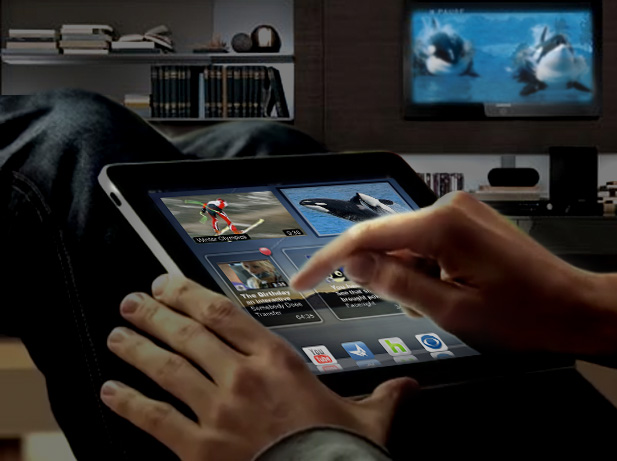
Vision for an iTV Remote: Tablets, laptops, and smartphones turn into TV remotes. Manage thousands of your favorite specialty videos and channels, all from your lap. Each viewer has their own second screen, for social viewing, chat, feedback, ratings, rankings, suggesting what to watch next, games, etc. A serious entertainment and education platform. (Artist: M. Rojas, Fizbit.com)

Big cable and telco companies, in bed with captured legislatures, are actively slowing down the arrival of iTV in the US, Australia, and several other industrialized countries dominated by Big Media today. These deviants are trying to keep our internet bandwidth below 100Mbps for as long as they can, because around that number, TV-quality internet streaming video platforms can emerge, platforms with millions of channels, and which use much more clever and lower cost methods (highly personalized and localized commercials, subscriptions, micropayments, AdSense, etc.) of monetizing custom video content. iTV will take away Big Media’s monopoly of the living room screen, and will massively fractionate their TV advertising market. It will also create an environment that will support hundreds of thousands of new, independent, full-time specialty video producers, remixers, and commentators, and facilitate massive new entertainment and nonfiction (education, documentary, civic engagement) video subculture emergence. This is something the 99% can get very excited about.

Unfortunately, US consumers so far have been slow to adopt any form of “lean forward” television, where they have to occasionally lean forward in their chairs to search for content using the keyboard. Google TV adoption, for example, even though it is a relatively inexpensive move away from the closed telco set-top box,  has been a lot slower than some expected. Logitech lost $100M on their Revue box for Google TV in 2010, and have announced they’ll be pulling out. They made far too many of them, and learned that the consumer is far less interested in messing with yet another incrementally useful household gadget than they anticipated. I really like my Revue, it has served us well all year, and Logitech could have built some good will by serving its small customer base a lot better this year, and teaming up with Best Buy or another electronics retailer to work out installation deals to get them into more houses. But I’m in that 3% of Americans (and rapidly rising) who watch TV shows online but don’t have cable, often on principle. Had Logitech focused on us, the best market for Google TV at present, they’d have found a willing audience. No matter, LG Electronics and other hardware makers will step in for the next version of Google TV, which will only get better faster, now that a new Apple TV is in the works for 2012. Consumers are waiting for better “lean back” experiences, where the platform will automagically decide what they are interested in, and feed it to them, and they can occasionally give feedback to it, preferably by voice. They’re waiting for Xbox and Apple to wow them with something totally simple and easy to use. This will happen, but it will also be something that is quite closed. Not as bad as the cable companies present offerings, but not nearly as open as the web. What we can continue to expect from the big corps, excepting the few, like Google, whose business model revolves around openness, will be more bread and circuses, while the media plutocrats keep the system rigged in their favor, and the little guy keeps getting shut out of the living room video marketplace, and 21st century social diversity, specialization, collective intelligence, and democracy continue to suffer.

How do we help the tech literate, discriminating consumer, the 20% who are opinion leaders, see that the current Big Media-run TV universe, with $60B of annual TV advertising in the US alone, and endlessly repetitive ads for far too many crappy products, is going to inevitably be remade into something that is far more customized and relevant to each of us? How do we get them to see the value of TVs that have both amazing lean forward features (even if only occasionally used) and very intelligent lean back features, and that are truly open video marketplaces? How do we accelerate the irreversible developmental move to a platform where lots of money flows not only to studios, but also to hundreds of thousands of small company specialty video producers, and where ads become so diverse and specialized and local and context sensitive that they aren’t ads, but education? Once the bandwidth arrives, I expect (and hope) that better and far more open iTV platforms will be built, and people, starting with the youth, will migrate to them in droves. Big Media will likely still get 80% of the revenue, and provide 20% of the “fat head” of the distribution. But we’ll also have lots of Little Media, getting 20% of the revenue, and delivering 80% of the variety, the “long tail” of diversity on the video web.  And we’ll have a different kind of Big Media, corps that have adapted to a more service-oriented model, or died.  The world will be a much smarter (and more entertaining) place.

Here are ten reasons to get excited about the near future (circa 2020?) promise of iTV. In the meantime, I hope they help you become an early adopter of the most open access, true internet television you can get:

  1. 1 million+ specialty video channels on your TV. A worthy video platform for a 21st century democracy.
  2. Americans spend half their free time watching TV. They need much better and more specialized news, entertainment, and education.
  3. We all need the ability to like, dislike, and ban any types of ads that come into our home that we don’t want. Only ads you care about will be allowed into your home. Finally.
  4. Our tablets, smartphones, and laptops will become our iTV remotes, and our game controllers for amazing new iTV games.
  5. Social viewing, chat, and collaboratively filtered recommendations will be central to the best open platforms. Facebook, Google+, Twitter, etc. will help us find good content.
  6. We need user-customized commercials, with half-muting, or full muting with captions, of whatever duration we want (10, 12, 18 mins per hour, etc.). Watch more commercials, you automatically get access to more expensive, ad-supported content. Want to watch less ads? Pay a channel subscription, or micropayments for premium video.
  7. Realtime customized captions & sidebars. Never again watch news, or politician’s harangues, without great social commentary and analysis running in realtime in the side bar.
  8. Open source video licenses on video content will bring peer-to-peer, mashup culture to video, and greatly improve video content.
  9. If copyright holders offer a rental license to anyone, they must also offer a remix license, priced no higher than the rental license. This is law in some states, based on the editing licenses that Hollywood sells for edited versions of movies that play on TV, in airplanes, etc. This needs to become federal law, to empower global remix and editing culture.
  10. It’s time for a hundred competing specialty channels of [your interest here] TV!
Action Items: Share this post around, if you agree with it. Critique/improve it where you don’t. Be an early and preferential adopter of Google TV, Boxee, (Amazon?) and any of the most open, most citizen-empowering video platforms to come, run by companies or startups that are the most dedicated to open web access and open media empowerment. Choose these over XBox, Apple TV, and other more closed, yet often prettier platforms, both now and in their better versions to come. Use BitTorrent, BinTube, or other peer to peer video sharing solutions aggressively, to force big telcos and cable to upgrade their crappy networks. Push digital pigs through their tiny pipes. Seed and share open source and creative commons video content. Donate to and support the Open Video Alliance, openvideoalliance.org

For more, see my:

• 20 min video, The Television Will Be Revolutionized, TEDx Del Mar, 2010.

• 2-page summary, How the Television Will be Revolutionized, Accelerating.org

• 4-page article, Tomorrow’s Interactive Television, The Futurist, Nov-Dec 2010

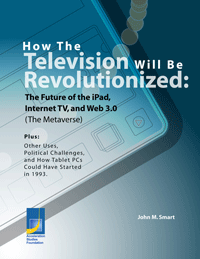
• 48-page whitepaper, How The Television Will be Revolutionized, 2010.

  Thoughts? Comments? Let me know, thanks. [tweetmeme source=”johnmsmart” only_single=false]